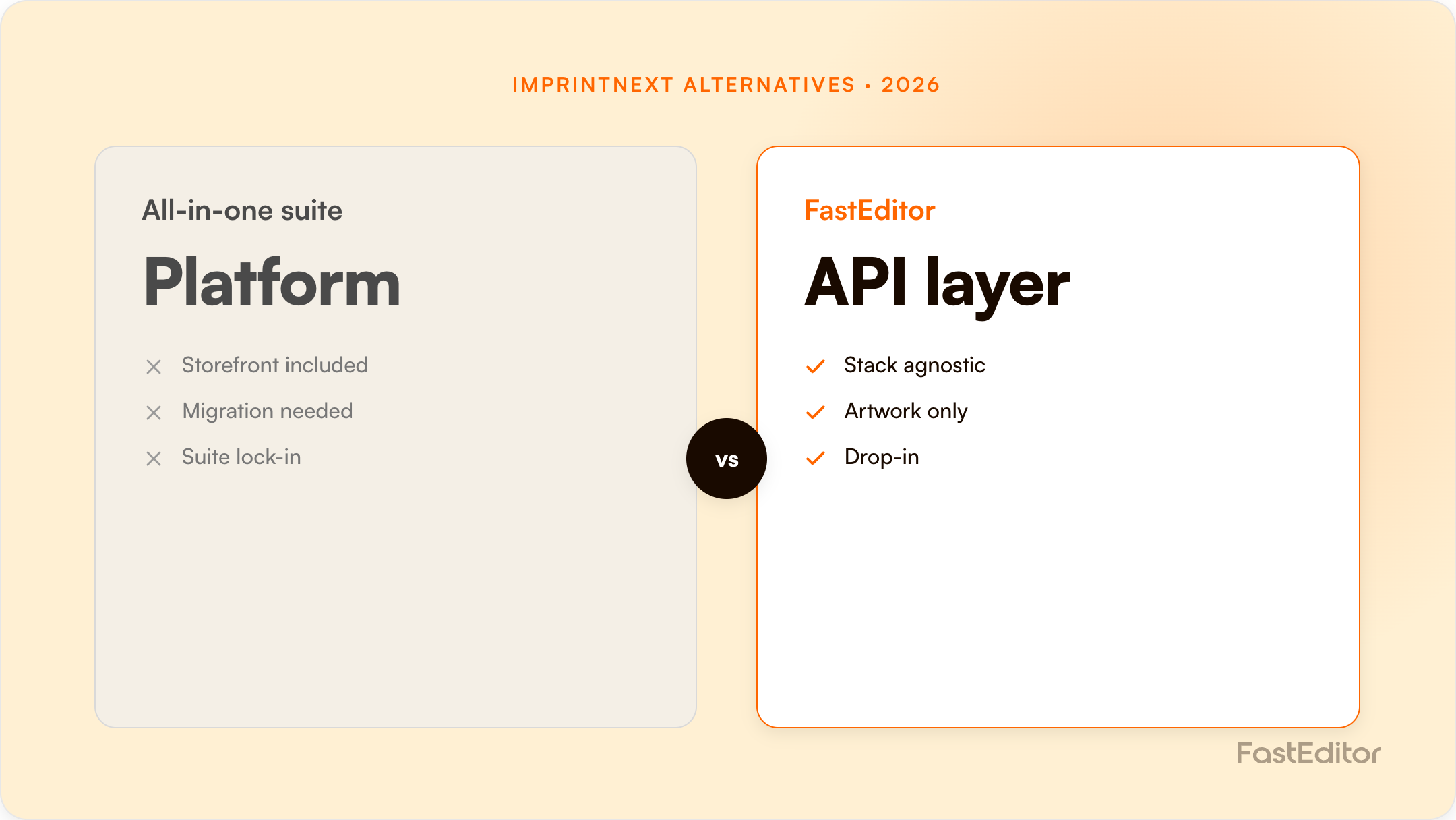
ImprintNext bundles an online designer with print-shop business tools. FastEditor is a focused, API-first artwork-automation layer: it vectorizes uploads, enforces per-supplier specs, and outputs a production-ready file across 150+ suppliers, plugging into your existing systems.
Looking for an ImprintNext alternative? ImprintNext pairs an online product designer with business tools for print shops and decorators, such as order management, quoting, and admin. Teams look for an alternative when their priority is not an all-in-one business suite but a focused automation layer that turns customer uploads into a production-ready file and plugs into the systems they already use. This guide compares the two honestly, including where ImprintNext is strong.
On this page
ImprintNext gives you a designer and a workflow, but turning every raw customer upload into a spec-correct production file is a different, deeper problem. FastEditor is built specifically for it: it vectorizes the upload, validates it against per-supplier specs with automated line-thickness and preflight checks, and outputs a production-ready file, the core of artwork automation. FastEditor reports up to 80% lower cost per order and 99.95% file accuracy.
FastEditor concentrates on the artwork layer rather than bundling a business suite, and it plugs into the commerce and order systems you already run. It ships with 150+ promotional-product and apparel suppliers pre-integrated, each with its own decoration methods, imprint areas, and file requirements, so specs are enforced automatically. For resellers and suppliers scaling personalisation across many suppliers, that depth and reach is the differentiator.
You keep the systems you already use. FastEditor connects via API or native connectors for Shopify and WooCommerce, so the migration maps your catalogue and decoration methods, connects the relevant suppliers, embeds the editor, and routes output into production, usually live in about 3 to 4 weeks.
If you want one system that combines a product designer with print-shop business management, ImprintNext is a strong all-in-one. If your priority is deep artwork automation, supplier-spec enforcement, and production-file output that plugs into your existing stack, FastEditor is built for that. Size the impact with the ROI calculator or see our case studies.
ImprintNext is unusual in this field: it is sold as a one-time perpetual licence, self-hosted on your own server, with no monthly fee.
| Plan | Price (USD, one-time) | Was | Notes |
|---|---|---|---|
| Essential | $2,999 | $3,499 | 3 months free standard support |
| Pro | $3,999 | $4,999 | Adds embroidery preview, wide-format print |
| Enterprise | Ask for price | Multi-vendor marketplace, custom |
The licence covers installation in up to three e-commerce stores you own or control. Installation is free, and the vendor states there are no hidden fees. Free support runs from 2 to 24 months depending on plan; after that, support is chargeable, non-recurring and unpriced. Refunds are available within 30 days minus a 10 to 15% cancellation fee.
One flag on freshness: the pricing page carries a "BlackFriday Deal! Valid till 2nd December" banner but was showing these prices in August 2026. Treat the discounted figures as the effective list price rather than a limited offer. Note also that no free trial is advertised on the vendor's own site, despite some third-party directories claiming otherwise.
| Capability | ImprintNext | FastEditor |
|---|---|---|
| Commercial model | One-time licence, self-hosted on your server | SaaS subscription plus per-file fee |
| Online designer | Yes, broad: curved text, 5,000+ cliparts, hand-drawing, QR codes | Yes, focused on logo and photo |
| Decoration methods previewed | Screen print, embroidery, DTG, sublimation, heat transfer, rhinestone, laser, vinyl, offset, UV, digital | Screen print, embroidery, pad print, digital, laser and more, per supplier spec |
| Print-ready output | Yes: CMYK production files in PDF, SVG, PNG, plus work orders | Yes, per supplier spec |
| Vectorization of customer uploads | Yes, a "Vectorize Image" function; quality thresholds not published | Yes, automatic, with preflight against the chosen method |
| Supplier decoration specs | Supplier catalogues integrated for products; decoration specs are configured by you at setup | 150+ suppliers with imprint areas, methods and colour limits pre-integrated |
| Back office: orders, production, CRM, vendors | Yes, a full suite | No |
| Public API | Not publicly documented | API-first, documented |
Credit where it is due: ImprintNext is the only vendor in this comparison set that publicly advertises vectorization of customer uploads. That closes the single biggest gap the others leave open. What it does not publish is what happens next, namely whether the vectorized file is validated against a specific supplier's imprint area, colour limit and minimum line thickness for the method chosen. On the public site, decoration settings are configured by you during setup rather than ingested from the supplier.
If you want to own the software outright, run it on your own infrastructure, and avoid a recurring subscription entirely, ImprintNext is a rational purchase and the price is modest against a multi-year SaaS commitment. If you also need order management, production management, CRM and vendor purchase orders, you are getting a complete business suite in that same one-time fee, which no subscription vendor here matches. Self-hosting also answers data-residency questions cleanly.
The costs are the ones that come with any self-hosted suite: your server, your upgrades, your uptime, and support that is chargeable once the free window closes. There is also no public API documentation, which matters if you intend to build around it rather than in it.
Pricing checked 14 August 2026 from each vendor's public pages and marketplace listings. Vendors change plans often, so verify before you commit.
No. FastEditor focuses on artwork automation and integrates with the order and commerce systems you already use, rather than replacing them.
Yes, via API or native connectors for Shopify and WooCommerce, plus custom stacks.
Most API-first integrations are live in about 3 to 4 weeks.
More articles in Comparisons.
