TL;DR
In quote-first and offline promo sales, an order begins as a visual proof the customer signs off, after which a studio manually rebuilds a production file. That rebuild is where time and margin leak. Artwork automation makes the approved proof and the supplier-ready production file outputs of one pipeline, so the file a customer approves is already validated and manufacturable, with no second build.
The quote-first order, and where it leaks
Plenty of promotional product orders never start in a shopping cart. A reseller talks to a client, puts a logo on a product, and sends over a visual for approval. The client replies 'yes, go ahead'. Only then does the order become real, and only then does someone sit down to rebuild that approval into a file the supplier can actually print. That rebuild step, repeated on every order, is one of the quietest margin leaks in the business.
The approval document has a name in print: the proof, or in French the BAT, the bon a tirer, the 'good to print'. In a quote-first workflow it does double duty. It is the sales artefact that closes the deal, and it is supposed to be the specification the factory works from. In most setups it is only the first of those. The customer approves a nice-looking preview, and a studio operator then recreates the artwork as a production file, re-checking colours, outlines, print area and resolution by hand. At FastEditor we see this gap constantly, and it is exactly the gap automation is built to close.
A preview is not a production file
The core problem is that an approval image and a production file are different things, a point we make in detail in product configurator vs artwork automation. A preview exists to look right on screen. A production-ready file has to run on a press, engraver or embroidery machine with no manual intervention: correct vector format, the right colour space, spot colours mapped, resolution sufficient at the real output size, and artwork that fits the decoration area. A good-looking proof can hide every one of those problems. The customer signs off on the picture, and the defects surface later, in the studio or at the supplier, as a reprint or a rejected job.
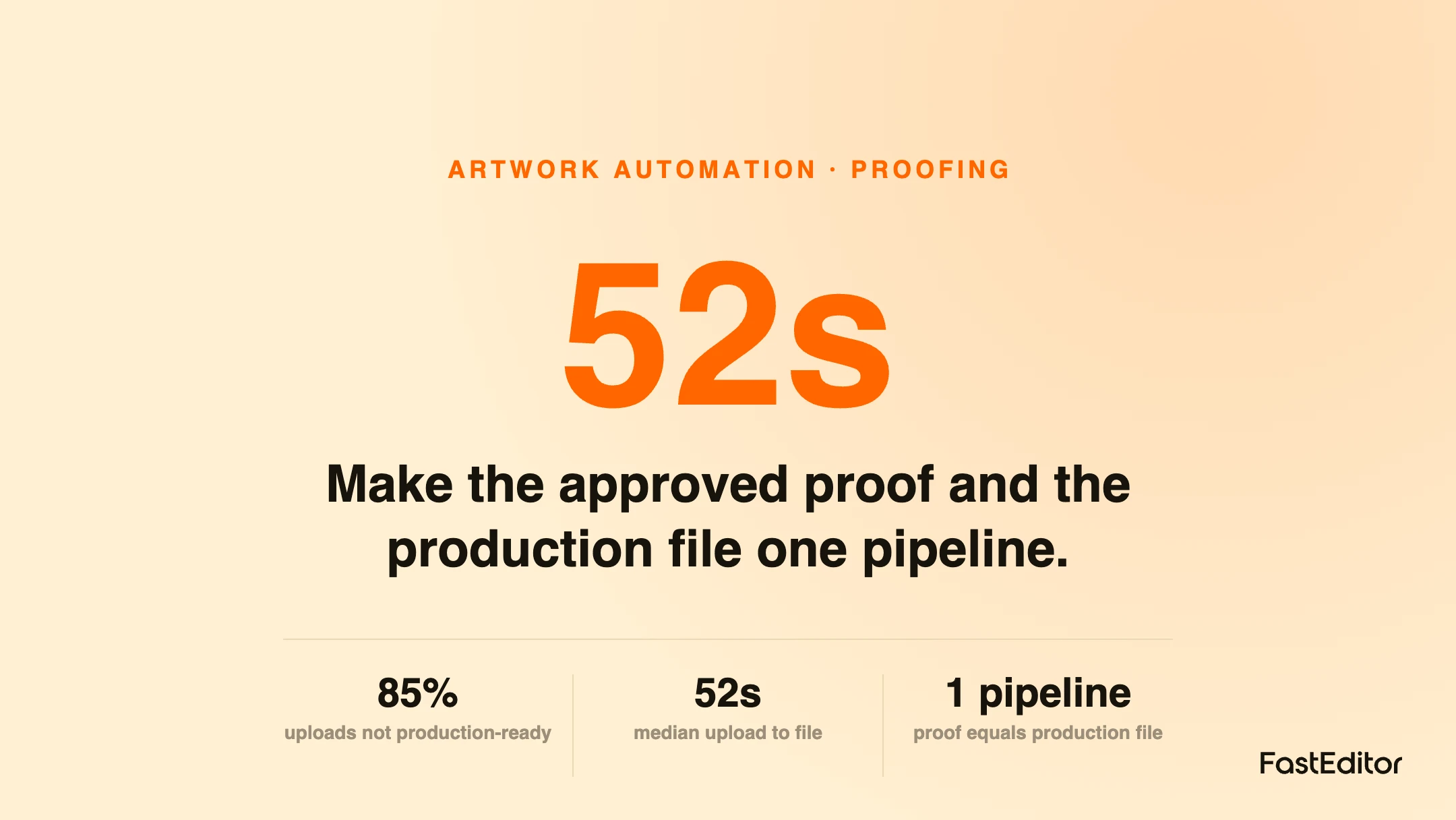
The FastEditor Artwork Automation Benchmark puts a number on how common this is: about 85% of uploaded logos are not production ready as submitted. If the proof is built from the raw upload, then roughly five in six approvals are approving a file that still needs work. Automating the proof without automating the file underneath it just makes the leak faster.
One pipeline, from approved proof to production file
The fix is to make the proof and the production file two views of the same validated artwork, not two separate builds. When a logo is uploaded, the pipeline prepares and validates the artwork: it vectorizes it, removes the background, matches colours to the method, and checks line thickness and print area. The print proof the customer sees is a rendering of that already-validated artwork. The compliant production file is generated from the same validated artwork when the order is triggered, through the configured Sales Notification or a Studio Tool production-package request, so approval and production reference the same object with nothing left to rebuild.
This is what turns a quote-first workflow from a two-step manual process into one automated flow: upload, see an accurate proof, make a small adjustment if needed, approve. A branded proof document makes that approval feel professional and closes faster, and because the file behind it is already supplier ready, the time from 'yes' to 'sent to production' collapses. In the benchmark, the automated path from upload to a production-ready file runs in a median of 52 seconds, which is the difference between same-day and next-week on a quote-first order.
Decoupling the file from the checkout
Quote-first selling has one more wrinkle: the production file is often needed before any checkout happens. A reseller builds a visualisation and a quotation, then creates the real order in their own back office, and their internal processes need the finished files at that point, not after an online payment. We have had this exact conversation with partners whose configurator is used mostly for visualisations and quotes rather than direct purchases.
The answer is to decouple file generation from the checkout event. Instead of tying the production file to a completed online sale, the system exposes a clear trigger that says 'generate the files now', which a partner can call when the quote is accepted in their own system. Our piece on using the editor beyond checkout covers this pattern. The point for a quote-first business is that the approved proof, the production file and the order can line up on your timeline, not the cart's.
What it takes to automate this
Three things make this work in practice. Accurate product data, so the proof reflects the real print area, method and colour limits for that specific item. An artwork pipeline that validates and corrects on upload rather than at the supplier, so the file under the proof is genuinely production ready. And a proof that is honest, showing the customer what will actually print, including a side-by-side where the artwork had to be corrected, so approval means something. Get those right and the proof stops being a pretty picture that creates work later. It becomes the production file, wearing a nicer coat.
Frequently asked questions
What is a BAT, or bon a tirer?
It is the approved print proof: the visual a customer signs off before production, literally 'good to print'. In a quote-first workflow it should serve as both the sales approval and the production specification, but only if the file behind it is genuinely production ready.
Why not just send the approved proof to the supplier?
Because a proof is built to look right on screen, not to run on a machine. Unless it is generated from validated, production-ready artwork, it can hide colour, resolution, outline or print-area problems that the supplier will reject. The goal is to make the proof a view of a file that is already manufacturable.
Can we generate the production files before an online order?
Yes. File generation can be decoupled from the checkout, so your system requests the finished files at the moment a quote is accepted in your own back office, rather than waiting for an online payment. That matches how quote-first and offline resellers actually work.
More articles in E-commerce and Conversion.
Key takeaways
- In quote-first and offline promo sales, the order starts as an approved proof, then someone rebuilds it into a production file by hand, which leaks time and margin.
- A preview is not a production file; about 85% of uploads are not production ready, so approving the picture is not approving a manufacturable file.
- Automation makes the proof and the production file two views of one validated artwork, so approval leaves nothing to rebuild.
- File generation can be decoupled from the checkout, so the files are ready when a quote is accepted, not only after an online payment.
- Accurate product data, upload-time validation and an honest proof are what make the approved proof equal the production file.
Want to map this to your own quote-first workflow? Get in touch.
Benchmark note: figures are drawn from the FastEditor Artwork Automation Benchmark 2026, across 32,435 logo uploads. See the full methodology.