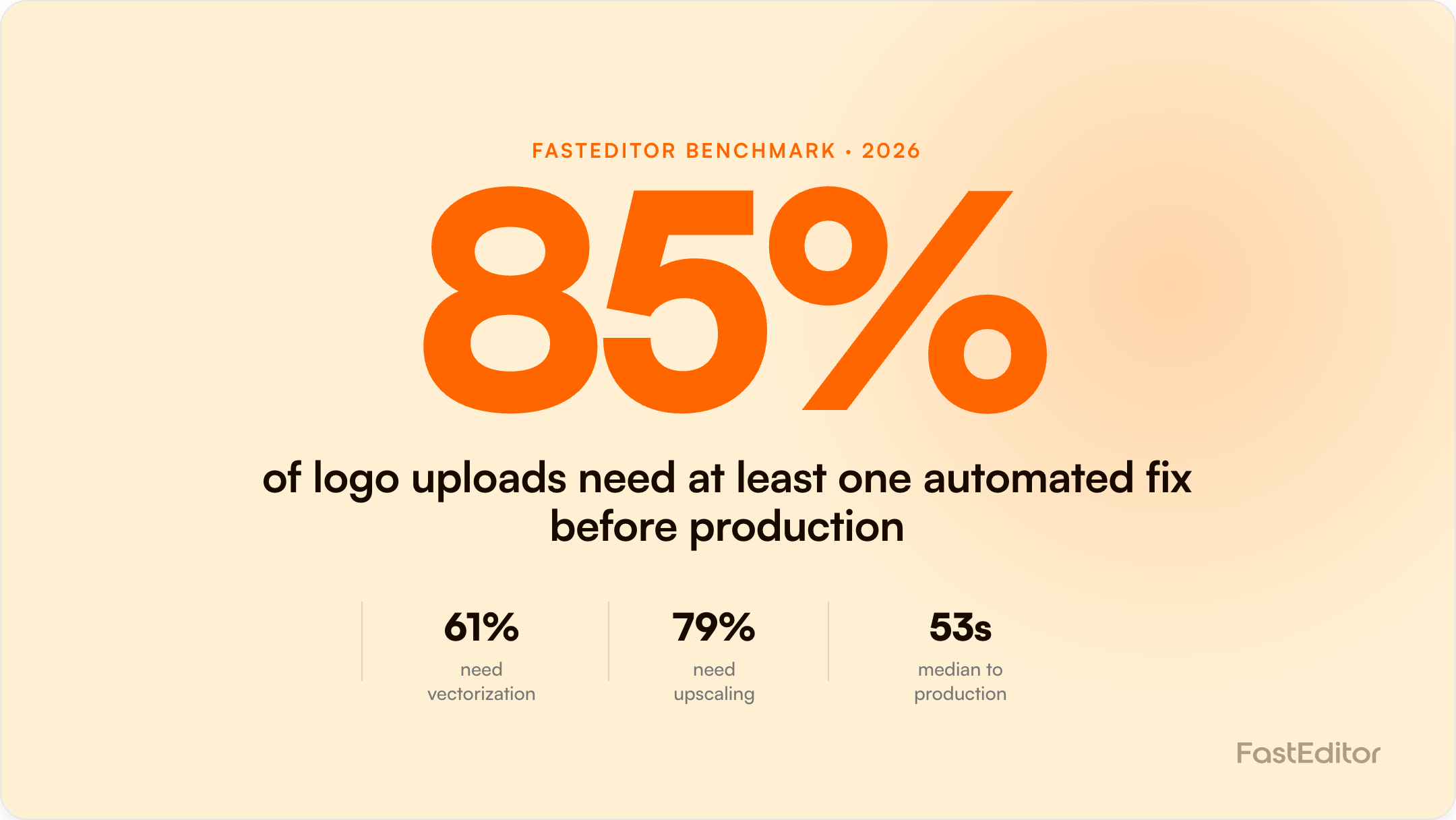
Across 32,435 logo uploads now analysed on the FastEditor platform, most arrive not production-ready. In the recent July to September 2026 window, about 85% needed at least one fix: 64% vectorization, 42% background removal and 83% upscaling on assessed raster uploads. Automated, the median time from upload to a production-ready file is 52 seconds.
The headline: across 32,435 logo uploads now analysed on the FastEditor platform, most artwork still isn't ready to print when it arrives. In the recent stable window (July to September 2026, 13,340 uploads), 64% need vectorization and 42% need background removal, and 83% of assessed raster uploads need upscaling. Yet the median time from upload to a production-ready file is just 52 seconds.
What held, and what moved
Doubling the sample barely moved the core numbers: vectorization (61% to 64%) and background removal (40% to 42%) held, upscaling held at roughly four in five assessed raster uploads, and median turnaround stayed around 50 seconds. One number did move: logos exceeding the printable colour limit rose from 3.5% to 8.6%, a sign that richer, more complex artwork is entering the pipeline.
On this page
Artwork automation is no longer an operational detail. It is a P&L driver. To size the problem with real numbers, we analysed every logo upload processed by the FastEditor Logo Editor across live distributor and supplier deployments. This is the first edition of an annual benchmark, now refreshed for the second half of 2026. Full definitions and limitations are on our Research Methodology page, part of FastEditor Research.
In the recent stable window (July to September 2026, 13,340 uploads), the FastEditor Logo Editor flagged automated correction on the majority of uploads:
Taken together, roughly 85% of uploads need at least one automated fix before they can go to production, consistent with FastEditor's production-spec standard.
What actually arrives in the upload queue
Share of customer logo uploads that needed each automated correction (July to September 2026).
FastEditor Artwork Automation Benchmark 2026 (2026 H2 refresh). Vectorization, background and colour rates measured on 13,340 uploads; upscaling on assessed raster uploads; July to September 2026. 32,435 uploads analysed in total.
Among logos where the editor detected distinct spot colours, the median upload uses just 2 colours and the average is about 4.5, but roughly 1 in 6 carry 8 or more colours, with a tail running to 14 to 20+. Those high-colour logos are exactly the ones that can't be screen-printed or embroidered without colour reduction, which is why the editor offers automated colour-merging at the point of upload. The share of uploads exceeding the printable colour limit rose from 3.5% to 8.6% between the first edition and this refresh, consistent with more complex artwork arriving in the queue.
The data shows active self-service, not passive acceptance of the auto-fixes. Customers reach for undo, colour-merge and colour-limit controls thousands of times each week, and many resolve a colour overflow on their own in seconds. It is the behaviour of people completing a production-ready design, not waiting on a designer or a proofing email.
In a traditional workflow, a customer who uploads a logo is lucky to receive a print proof within 24 hours, and, when no revisions are needed, lucky to be in production within three working days. On the FastEditor platform, the median time from upload to a production-ready file is 52 seconds, covering analysis against the supplier's production specs, vectorization or background removal where needed, placement, and proof generation.
The automation flywheel, in numbers
Logo uploads analysed
32,435
19 Nov 2025 to 11 Oct 2026
Production-ready files auto-generated
17,518
full window
Growth vs first edition
2.4x
cumulative uploads since Edition 1
Median upload to production file
52 sec
July to September 2026
FastEditor Artwork Automation Benchmark 2026 (2026 H2 refresh), aggregated anonymized platform data.
The cumulative sample has more than doubled since the first edition, from 13,773 to 32,435 logo uploads, and monthly volume reached a high of more than 6,000 uploads in September 2026, the signature of automation moving from pilot to default workflow.
| Metric | Edition 1 (Mar to May 2026) | 2026 H2 refresh (Jul to Sep 2026) |
|---|---|---|
| Need vectorization | 61% | 64% |
| Need background removal | 40% | 42% |
| Need upscaling (assessed raster uploads) | 79% | 83% |
| Exceed colour limit | 3.5% | 8.6% |
| Median upload to production-ready | 53 sec | 52 sec |
| Need at least one fix | ~85% | ~85% |
| Total logo uploads analysed (cumulative) | 13,773 | 32,435 |
| Production-ready files auto-generated (cumulative) | 7,918 | 17,518 |
All figures are aggregated, anonymized event data from live FastEditor deployments, measured in Amplitude. Headline fix rates are reported on the recent stable window (July to September 2026): vectorization, background and colour rates on 13,340 logo uploads, and upscaling on assessed raster uploads in the same window. Cumulative volumes span 19 Nov 2025 to 11 Oct 2026. The ~85% 'at least one fix' figure reflects FastEditor's production-spec standard and is corroborated by the per-fix rates above. Categories overlap: one upload can need more than one fix. Full definitions, windows and limitations are on our Research Methodology page.
For distributors, the proof-creation queue is structurally large, and traditionally paid for in DTP hours and slow proof-to-order conversion. Pushing correction to an automated, self-serve step at the point of upload turns a cost centre into conversion, and you can size that impact with the ROI calculator. For suppliers, comparing every upload against stored production specifications before the order is confirmed removes the mismatch, the reprints and the production delays. Learn more in our complete guide to artwork automation, or see how distributors use it in our case studies. For a closer look at exactly which checks catch these issues the moment a file is uploaded, see what automated artwork checks actually catch.
More articles in Artwork Automation.
Yes. This is the 2026 H2 refresh, covering 32,435 logo uploads through October 2026. The core rates held as the sample more than doubled; see Methodology for how we measure.
About 15%. In the July to September 2026 window, roughly 85% needed at least one automated fix, such as upscaling, vectorization or background removal, before they could go to production.
A median of 52 seconds from upload to a production-ready file, compared with up to 24 hours for a manual proof and around three working days to reach production in a traditional workflow.
64% of uploads needed vectorization, because raster files can't go to screen print, embroidery or laser without being converted to vector first.
83% of assessed raster uploads were too low-resolution for production. Customer logos are typically small, web-grade files that won't hold up in print without upscaling.
Artwork automation is the automated analysis and correction of customer-uploaded artwork, including vectorization, upscaling, background removal, colour checks and proof generation, against a supplier's production specifications. It turns a manual DTP step into a self-serve one at the point of upload.
From aggregated, anonymized product-analytics events across live FastEditor deployments, measured in Amplitude, from 19 Nov 2025 to 11 Oct 2026. Headline fix rates are reported on the stable July to September 2026 window. Full detail is on our Research Methodology page.
Cite this benchmark: FastEditor Artwork Automation Benchmark 2026 (2026 H2 refresh), fasteditor.com.
