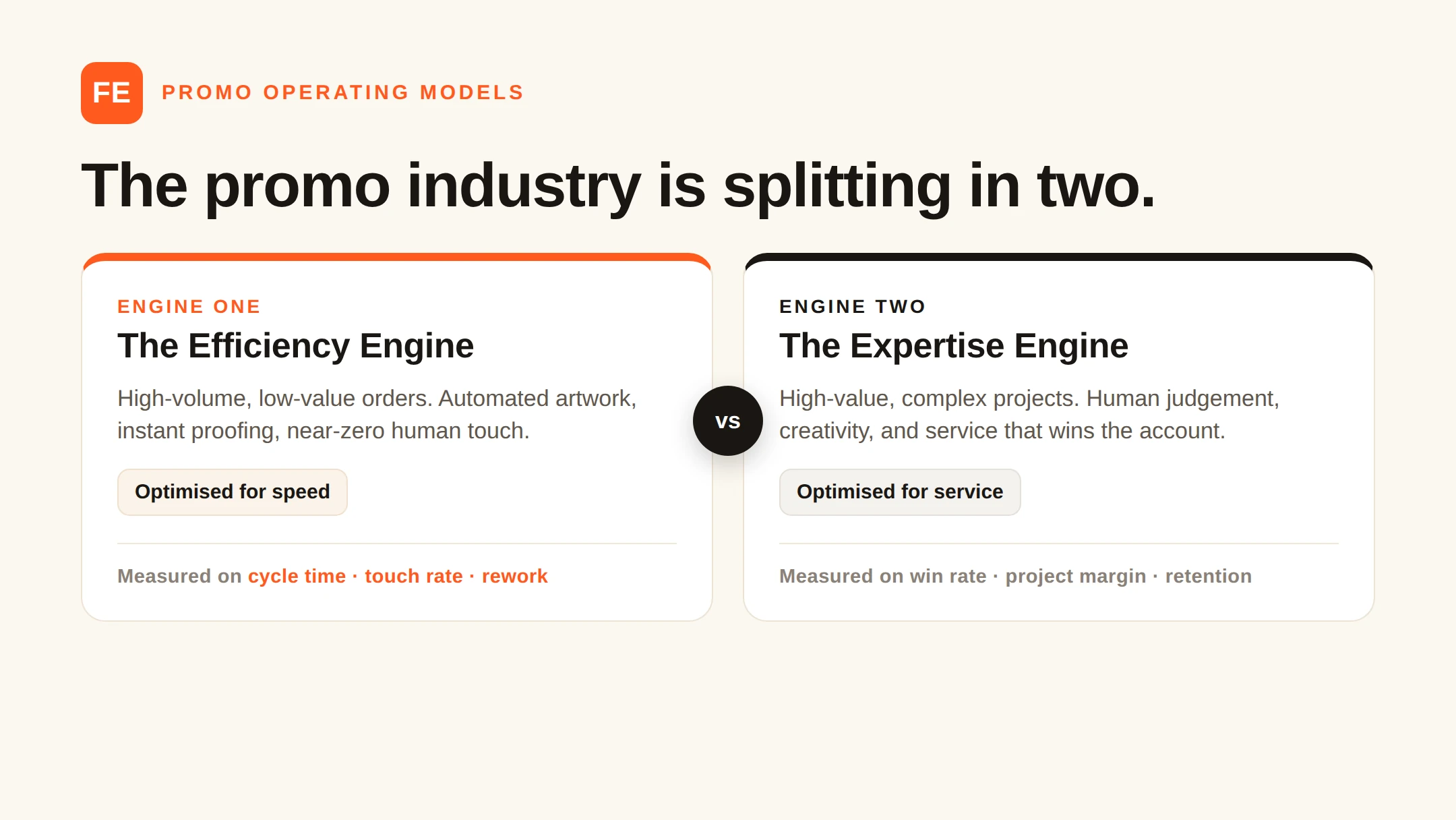
The promotional products industry is dividing into two order types: high-volume, low-value work that must be instant and automated, and high-value, complex projects that need human expertise. Serving both with one process erodes margin. The fix is a two-engine operating model, one tuned for speed and one for service, with a clear handoff between them.
Two orders land in your inbox on the same morning. The first is 250 branded pens for a returning customer who reorders every quarter, same logo, same colours, same shipping address. The second is a full merchandise programme for a new client: custom packaging, four decoration methods, a colour-matched brand palette, and a launch date that cannot move. Your team runs both through the same process. The same people, the same proofing steps, the same email threads. One of those orders makes you money. The other quietly loses it. And the uncomfortable part is that you probably cannot tell which is which until the month closes.
On this page
This is the story of almost every promotional products business right now. The market is separating into two very different kinds of work, and most companies are still trying to serve both with one set of processes. That middle ground is exactly where margin goes to die.
The promo industry is quietly splitting in two, and most companies are stuck in the middle. On one side you have high-volume, low-value orders that need to be instant, automated, and scalable. This is the world of reorders, small quantities, standard products, and simple decoration. Buyers here expect an ecommerce experience: upload a logo, see a proof in seconds, place the order, done. In this lane, automated artwork flows, instant proofing, and production efficiency decide your margins. Speed is not a nice-to-have. It is the product.
On the other side you have high-value, complex projects that require real human expertise and service. Brand programmes, new product development, unusual materials, multi-method decoration, tight timelines, and demanding stakeholders. These orders are won and kept by people, not by portals. The buyer is paying for judgement, reassurance, and a partner who can solve problems that do not fit a template.
Both types of work are legitimate. Both can be profitable. The problem is that they reward completely opposite operating models, and the average company runs a single process that is tuned for neither.
The automation flywheel, in numbers
Logo uploads analysed
13,773
19 Nov 2025 to 31 May 2026
Production-ready files auto-generated
7,918
full window
Growth in monthly uploads
~11x
Nov 2025 to May 2026
Median upload to production file
53 sec
2,201 uploading users
FastEditor Artwork Automation Benchmark 2026, aggregated anonymized platform data.
When you serve both lanes with the same process, you get the worst of both worlds. Manual work kills your low-value orders. The moment a human has to touch a 40-euro reorder, redraw a logo, chase an approval, or rekey a spec, the margin is gone. The order was never big enough to absorb an hour of skilled labour, but that is exactly what your one-size process spends on it.
The reason those small orders need a human at all is almost always the artwork. In our own Artwork Automation Benchmark across 13,773 real logo uploads, about 85% of the files customers sent were not print-ready.
85% of 13,773 uploaded logos were not print-ready. That is the hidden manual work quietly eating your low-value lane. Source: FastEditor Artwork Automation Benchmark.
At the same time, over-automation kills your high-value relationships. When a client running a six-figure programme gets pushed through the same self-service funnel as a pen reorder, they feel it. The thing they are paying for, expertise and attention, is precisely what the automated path strips out. You win the efficiency and lose the account.
Put a number on it and the leak is obvious. Artwork handling runs about 45 euro per order, and it is a fixed cost per order, not per unit, so it hurts the small orders most. On a typical 225-euro order it quietly halves the margin you thought you had.
| Line | Amount |
|---|---|
| Order value | 225 euro |
| Gross margin pool (30%) | 67.50 euro |
| Artwork handling (fixed per order) | 45.00 euro |
| Margin left after handling | 22.50 euro, about 10% |
A single process cannot be optimised for both instant throughput and deep service at the same time. Every compromise you make to speed up the complex work makes the simple work slower, and every safeguard you add for the complex work adds friction to the simple work. The result is an 'average' process that is too slow and expensive for your cheap orders and too rigid and impersonal for your expensive ones. That is not a strategy. That is a margin leak with a workflow diagram.
It is tempting to read the split and conclude that you have to choose: become a lean automated fulfiller, or become a high-touch creative agency. That is the wrong lesson. It is not about choosing one lane. It is about designing two completely different engines inside the same business. One engine optimised for speed and automation. One engine optimised for creativity and service. Same company, same brand, two deliberately different ways of moving work through the door.
| Dimension | Efficiency engine | Expertise engine |
|---|---|---|
| Order type | High-volume, low-value, repeatable | Low-volume, high-value, complex |
| Goal | Instant throughput at low cost to serve | Deep service, judgement, and creativity |
| Human touch | By exception only, never by default | Human-led, with automation around the expert |
| Key tooling | Automated vectorization, instant proofing, production-ready files, a configurator | Specialists supported by fast artwork prep in the background |
| Success metrics | Cost to serve, touch rate, proof-to-order conversion, cycle time | Project margin, win rate on complex bids, client retention |
| Failure mode | A human quietly absorbing artwork rework on a tiny order | A specialist buried in admin instead of high-value work |
The efficiency engine exists to move high-volume, low-value orders through with as close to zero human touch as possible. Its job is throughput and consistency. The design principle is simple: a human should only ever touch an order in this engine by exception, never by default.
Concretely, that means the artwork problem has to be solved by web-to-print software, because artwork is where these orders silently stall. If a person has to fix each not-print-ready file by hand, your low-value lane is dead on arrival. The efficiency engine leans on FastEditor for automated vectorization to turn a customer logo into a clean production file in seconds, instant proofing so the buyer approves without a back-and-forth, and production-ready file generation so what the customer approves is exactly what the machine prints. Wrap that in a product configurator and the order places itself.
The metrics that matter for this engine are cycle time, touch rate (what share of orders needed a human), automated proof approval rate, and rework. If those numbers are healthy, the engine is doing its job, and the small orders you used to lose money on start contributing again.
The expertise engine exists to win and deliver high-value, complex projects. Here the scarce resource is not machine time, it is your best people. So the design principle inverts: automate everything around the expert so that their hours go to judgement, creativity, and relationship, not to admin.
The expertise engine still uses automation, but as a tool in the expert's hands rather than a replacement for them. A specialist should be spending time on decoration strategy, material choices, and reassuring a nervous client before a launch, not manually preparing files or building proofs from scratch. Give them fast tooling in the background and their capacity for the work that actually justifies the margin goes up.
The metrics here are completely different: win rate on complex bids, project margin, client retention and reorder value, and net revenue per specialist. Cycle time barely matters. A programme that takes three weeks and delights the client is a win. The same three weeks spent on a pen reorder is a disaster. Same clock, opposite meaning, which is exactly why the two engines cannot share one process.
The clearest way to see why one process fails both lanes is to put a typical order from each on the same page. Both streams run at a 30% gross margin. What differs is the basket value, the work each order demands, and where the profit ends up.
Start with the automated stream: high-volume, low-value orders around 250 euro. Run manually, the artwork alone eats most of the margin. Automate it and the same order becomes properly profitable.
| Automated stream (per order) | Manual today | With automation |
|---|---|---|
| Average basket value | 250 euro | 250 euro |
| Gross margin (30%) | 75 euro | 75 euro |
| Sales | 10 euro | 6 euro |
| Design and artwork | 45 euro | 9 euro |
| Account management | 8 euro | 4 euro |
| Total operational cost | 63 euro | 19 euro |
| Profit per order (pre-marketing) | 12 euro | 56 euro |
| Profit as % of basket | 4.8% | 22.4% |
Manually, a 250-euro order returns about 12 euro, and a single artwork revision or a rejected proof turns it into a loss. Automating the artwork, where about 85% of uploaded logos arrive not print-ready, removes up to 80% of the manual proofing work and lifts profit per order from 12 euro to 56 euro. That is the same order at roughly 4.7 times the profit, and it scales because no human touches it by default.
Now the high-value stream: complex projects around 2,000 euro. These carry far more operational cost, including purchasing and sourcing, yet they are where the real money sits.
| High-value stream (per order) | Amount |
|---|---|
| Average basket value | 2,000 euro |
| Gross margin (30%) | 600 euro |
| Sales (consultative) | 90 euro |
| Design and artwork | 70 euro |
| Account management | 50 euro |
| Purchasing and sourcing | 40 euro |
| Total operational cost | 250 euro |
| Profit per order (pre-marketing) | 350 euro |
| Profit as % of basket | 17.5% |
The operational cost on a high-value order is roughly four times higher, 250 euro against 63 euro, because these projects genuinely need sales, design, account management, and purchasing. But the profit is not four times higher, it is far more: about 350 euro per order. This is the point a blended process hides. You do not protect these orders by making them cheaper to serve, you protect them by keeping the human expertise that wins them.
Put the two side by side and the strategy writes itself. The efficiency engine is a volume game that only works once automation turns a 12-euro order into a 56-euro one. The expertise engine is a profit-per-order game that easily carries four times the operating cost. Averaging them into one process, one team, and one dashboard optimises both into mediocrity.
Once you accept the two-engine model, the real challenge is not building either engine. It is deciding, order by order, which engine a piece of work belongs in, and moving it cleanly between them. As one reader put it after the original post, the challenge is not simply deciding what to automate, it is recognising when a customer or project needs to move from the efficiency engine to the expertise engine. Companies that define that handoff well protect both their margins and their relationships.
Get the handoff wrong in one direction and you route a complex, high-stakes programme through the self-service funnel, where it breaks and takes the client's trust with it. Get it wrong in the other direction and you burn a specialist's afternoon on an order the software should have closed in ninety seconds. The handoff is not a nice detail. It is the control system for the whole business.
.webp)
The good news is that most orders sort themselves cleanly if you write down the rules. Five questions at intake route almost everything to the right engine:
| Question | Points to the efficiency engine | Points to the expertise engine |
|---|---|---|
| Repeatability | Standard product and decoration the system already knows | New or non-standard work |
| Order value and margin headroom | Thin margin, no room for human hours | Margin comfortably covers expert time |
| Complexity | One decoration method on one product | Many methods, materials, or components |
| Relationship stakes | Transactional reorder | Strategic account worth many times this order |
| Risk and deadline | Low risk, flexible timing | Expensive mistakes or an immovable deadline |
Turn those five questions into an explicit routing rule at intake, and most of your orders will land in the right engine automatically. The remainder, the genuine edge cases, are exactly the ones worth a human decision.
You do not have to rebuild the company overnight. The move to a two-engine model is a sequence, and it can start this quarter.
| Step | What to do |
|---|---|
| 1 | Segment your last 12 months of orders. Split them by value, complexity, and whether a human had to intervene. Almost everyone is surprised by how much revenue sits in a long tail of small orders that quietly consume skilled time. |
| 2 | Find your true cost to serve per order type. Load in the real labour, not just materials and print. This is where the middle-ground margin leak becomes visible in numbers rather than gut feel. |
| 3 | Automate the artwork bottleneck first. Artwork preparation and proofing is the single biggest hidden cost in the low-value lane, and the easiest to remove with software. Remember that about 85% of the 13,773 logos in our benchmark arrived not print-ready, so this is the work that quietly eats the lane. Fixing it is what makes the efficiency engine viable at all. |
| 4 | Write the routing rule. Use the five-question filter above to decide, at intake, which engine each order enters. Make it explicit so it does not live only in one experienced person's head. |
| 5 | Free your specialists. Take the admin and file prep off your best people so their hours flow to the expertise engine, where the margin actually is. |
| 6 | Measure each engine on its own terms. Judge the efficiency engine on touch rate and cycle time, and the expertise engine on project margin and retention. Never average them into one dashboard, or you will optimise both into mediocrity. |
If artwork is what stalls your efficiency engine, that is exactly what FastEditor automates. The Studio Tool turns a customer logo into a proof and a production-ready file in about 30 seconds, and you can model the margin you would recover on your own order mix before you change a thing.
The two-engine logic shows up differently depending on where you sit, but no one escapes it. Suppliers and decorators feel it hardest in production: the pressure to accept small, complex, personalised orders at speed while protecting the economics of the line. This is where connecting products once and letting them flow automatically to every channel matters, so that a configuration built for one reseller becomes available across the network without manual rework. Resellers and distributors feel it in the buying experience: transactional customers want an instant, self-service online design and ordering path, while key accounts want a named human. Trying to give everyone the same experience means overspending on the small accounts and underserving the big ones.
Across all of them, the companies that figure this out early are already creating a serious gap. They reinvest the cost they recover on automated orders straight into the people who win the complex ones, so they get sharper on price and better at service at the same time. The rest will keep feeling constant pressure on both margins and customer experience, and will not fully understand why, because from the inside a single 'efficient enough' process always looks reasonable.
Not necessarily two teams, and rarely two disconnected systems. It means two clearly different workflows with different rules, different success metrics, and a defined handoff between them. Many companies run both engines on shared infrastructure, with automation doing the heavy lifting in the efficiency engine and supporting the experts in the expertise engine. The separation that matters is in process and measurement, not necessarily in headcount.
No. This is one order intake with a routing rule, not two businesses bolted together. Both engines can run on the same platform. The efficiency engine leans hard on automation for artwork, proofing, and production files, while the expertise engine uses the same automation quietly in the background so specialists spend their time on the work clients actually pay for. In practice the automation pays for itself, because removing manual artwork handling recovers most of that fixed 45-euro-per-order cost.
Only if you point it at the wrong orders. Relationships live in the expertise engine, and that is exactly where you keep the human touch. Automation belongs in the low-value lane, where a fast, error-free proof is a better experience for a transactional buyer than a slow manual back-and-forth. Applied correctly, automation protects relationships by freeing your best people to spend time on the accounts that deserve it. The relationship risk is a routing problem, not an automation problem.
Usually the efficiency engine, because that is where the hidden losses are largest and the fix is most mechanical. Automating artwork preparation and proofing on your high-volume, low-value orders tends to recover margin fast and frees up the very people you need for the expertise engine. Once the simple work runs itself, you have the capacity to invest in the complex work.
Two quick signals. First, your skilled people regularly spend time on small orders that cannot possibly justify their hourly cost. Second, your biggest, most strategic clients occasionally get handled by the same generic process as a one-off reorder. If either is happening, you are running one lane where you need two engines.
More articles in ROI & Business Case.
| The promo market is splitting into high-volume, low-value orders that reward automation and high-value, complex projects that reward human expertise. |
| Serving both with one process is where margin disappears: manual work kills the cheap orders, over-automation kills the expensive relationships. |
| The answer is two engines in one business, one tuned for speed and one for service, not choosing a single lane. |
| Artwork preparation and proofing is the biggest hidden cost in the low-value lane. About 85% of uploaded logos are not print-ready, so automating it is what makes the efficiency engine viable. |
| The hardest and most valuable discipline is the handoff: an explicit rule that routes each order to the right engine and moves work cleanly between them. |
| Measure each engine on its own terms. Averaging them into one dashboard drives both toward mediocrity. |
Benchmark note: 13,773 logo uploads were analysed in total (19 November 2025 to 31 May 2026). The correction rates quoted here are measured on the stable instrumentation window of 8,664 uploads, March to May 2026. See the full methodology.
