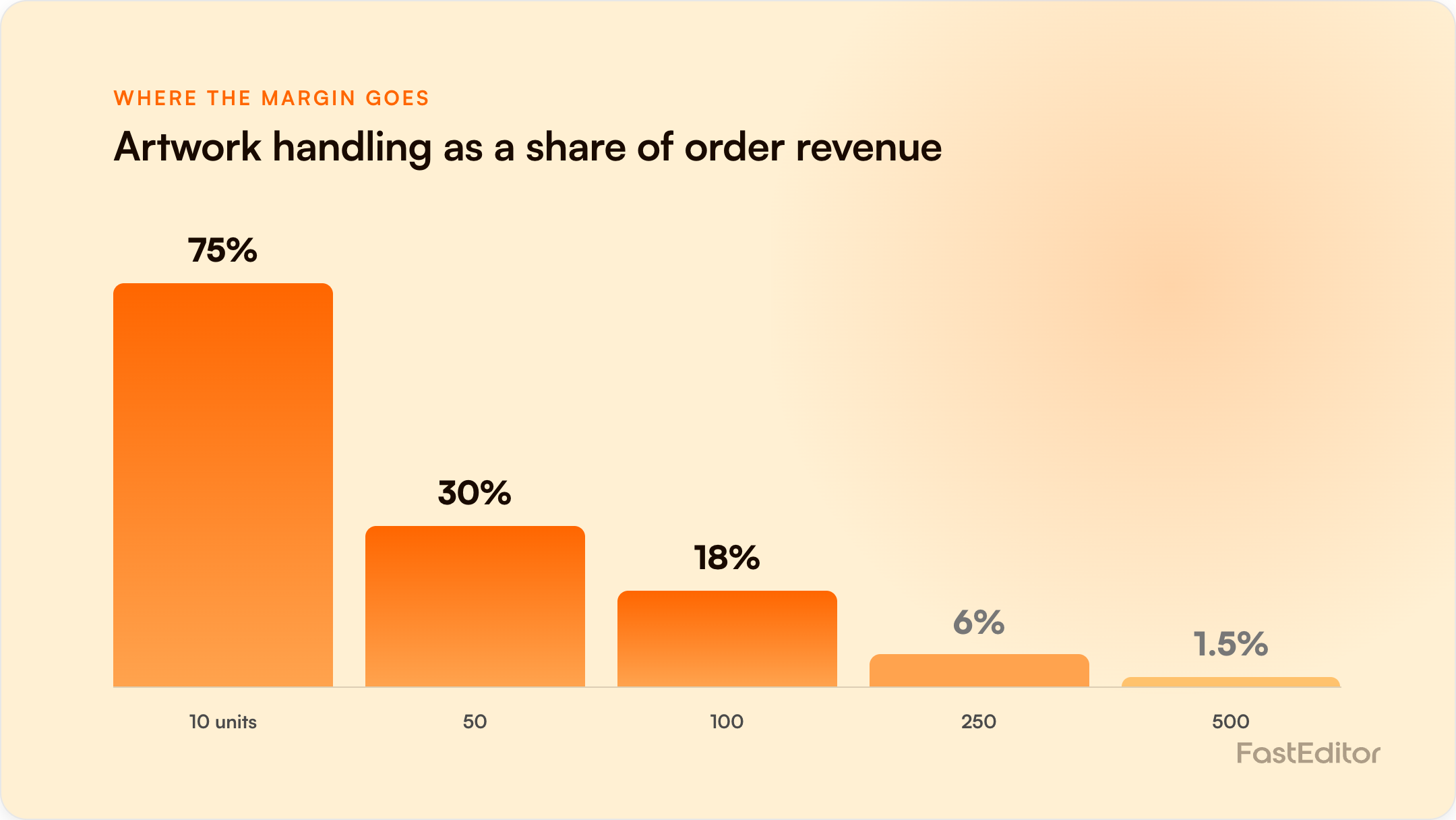
Artwork handling costs roughly €45 per order regardless of size, because the work does not scale with quantity. On a 10-unit order that flat cost can exceed the entire margin, while on a 500-unit order it is almost nothing. As orders shrink across the industry, more of them are quietly unprofitable.
Two orders land on the same morning. One is for 500 embroidered caps, the other for 10. Most teams treat the 500-unit order as the big win and the 10-unit order as easy money. The math says the opposite is closer to the truth: the small order is far more likely to lose money, and the reason is a cost that does not care how many units you print.
Artwork handling, the file check, designer prep, vectorization, proof creation, revisions, approval, and production-file prep, costs roughly €45 per order for screen print or embroidery. Crucially, that work is done once per order, not once per unit. The logo is checked once, vectorized once, proofed once, and prepared once, whether the run is 10 units or 500. In practice the effort per order does not scale with volume: the workflow is largely identical regardless of quantity.
That single fact changes everything about small-order economics. A fixed cost spread over very few units is brutal. Spread over many units, it disappears into the rounding.
The economics of one manual artwork order
Artwork handling cost
€45
per order, screen print or embroidery
Staff time absorbed
30-60 min
across file check, prep, proofing, approval
Proof-to-order conversion
~40%
so 60% of artwork effort never converts
Share that is manual DTP
up to 60%
of the total handling cost
The cost, conversion, and staff-time figures on this page are FastEditor operational estimates drawn from customer implementations, not externally published research. Cost per order rose from about €30 in 2019 to roughly €42 in 2024.
The table below works through four order sizes. To keep it concrete it assumes a €6 selling price per unit and a 30% gross margin target, with the artwork handling cost held flat at €45. The selling price and margin are illustrative; the flat €45 is the fully loaded handling figure.
| Order size | Revenue | Margin pool (30%) | Artwork handling | Net contribution | Handling as % of revenue |
|---|---|---|---|---|---|
| 10 units | €60 | €18 | €45 | − €27 | 75% |
| 50 units | €300 | €90 | €45 | €45 | 15% |
| 100 units | €600 | €180 | €45 | €135 | 7.5% |
| 500 units | €3,000 | €900 | €45 | €855 | 1.5% |
The 10-unit order does not just earn less. It earns nothing: the €45 of handling is more than double the entire margin pool, so the order is a loss before production even starts. The 50-unit order keeps only half its margin. Only at 100 units and above does handling fade into a tolerable share of revenue. The 30% margin on the quote is only real at volume; at small quantities it is a fiction, which is the clearest illustration of where the margin on a promotional order actually goes.
If small orders were rare, this would be a footnote. They are not, and they are becoming the norm. The market is shifting from bulk buying to on-demand: instead of ordering 1,000 units once, buyers now place several orders of 200, or fewer. Average order values are falling year over year, which means the fixed €45 is being spread across smaller and smaller runs. Every step down in order size pushes more orders below the profitability line. Low-volume, high-customization orders are the segment that becomes cost-prohibitive first. It is also why more distributors now split into two operating models, a fast automated engine for these orders and a separate expert engine for complex work.
Small orders carry a second penalty. Across the industry only about 40% of proofs convert to orders, and the cost of the 60% that never close has to be recovered from the ones that do. Small, exploratory orders are exactly the kind that generate proofs and then stall, so the effective handling burden on the small orders that do convert is even higher than the flat €45 suggests.
The problem is not small orders. The problem is paying a manual €45 to process them. Remove the manual artwork work and the fixed cost per order collapses, which is what makes small and on-demand orders viable again. When customers correct and approve their own artwork at the point of upload, the per-order cost drops sharply: the FastEditor Logo Editor cuts the cost of small orders by 20 to 30% and removes up to 80% of manual proofing steps, and the Studio Tool turns a quote into a proof and a production-ready file in about 30 seconds. It works because the underlying issues are automatable: platform data from 13,773 logo uploads shows about 85% are not production-ready and most need vectorization or upscaling. For the full per-order breakdown, see why artwork handling costs €45 per order, and to grow volume without growing the artwork team, see how to scale a promo business without hiring more designers. You can test the numbers on your own order mix with the ROI calculator.
More articles in ROI & Business Case.
Because artwork handling costs about €45 per order regardless of quantity. That fixed cost is done once per order, so on a small run it consumes a large share of revenue, and on very small orders it can exceed the entire margin.
In a worked example at €6 per unit, handling is 75% of revenue on a 10-unit order, 15% at 50 units, 7.5% at 100 units, and just 1.5% at 500 units. It becomes tolerable from around 100 units upward.
Yes. The market is shifting from bulk buying to on-demand ordering, with buyers placing several smaller orders instead of one large one. Average order values are falling, which spreads the fixed handling cost across fewer units.
By removing the manual artwork work that creates the fixed cost. Automating analysis, vectorization, and proofing at the point of upload cuts the cost of small orders by 20 to 30% and removes up to 80% of manual proofing steps.
Benchmark note: 13,773 logo uploads were analysed in total (19 November 2025 to 31 May 2026). The correction rates quoted here are measured on the stable instrumentation window of 8,664 uploads, March to May 2026. See the full methodology.
