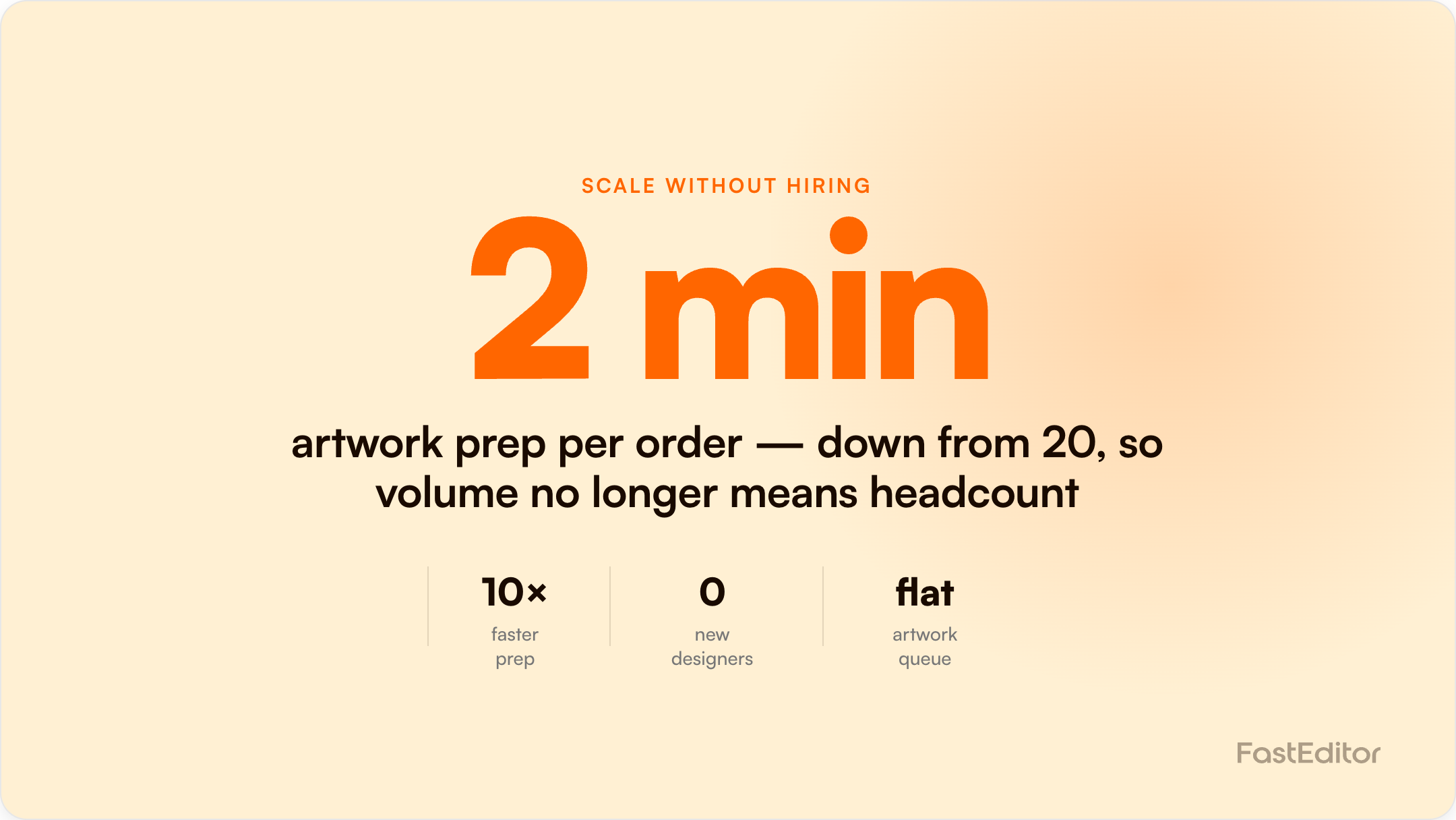
Each promo order needs 15 to 20 minutes of skilled artwork prep that is repetitive, not creative, so hiring designers only delays the wall. Automating intake, visualisation, proofing and production files cuts cost per order by around 80% across FastEditor integrations, as Helloprint's 80% time saving shows.
Every growing promo business hits the same wall. Orders are up, the artwork queue is longer, and the instinct is to post a job ad for another designer. Sometimes that is right. Usually it is not, because the queue is not a capacity problem, it is a process problem. Each order needs a file check, vectorisation, a mockup, a proof and a production file: roughly 15 to 20 minutes of skilled time that is repetitive, not creative. McKinsey's future of work research found that in about 60% of occupations, at least a third of activities could be automated with existing technology. Artwork prep is a textbook example.
On this page
At 200 orders a month, 15 to 20 minutes per order is 50 to 65 hours: half a full-time role spent on file cleanup. Double the volume and you need another designer. Double again and you need two more, plus a coordinator. Because the prep cost is fixed per order rather than per unit, it punishes exactly the orders growing fastest in promo: small, frequent, web-driven ones. Hiring does not remove the bottleneck, it just reschedules it. It is also what quietly caps variable branding programmes, where the same product is reproduced with a different partner logo on every order.
The automation flywheel, in numbers
Logo uploads analysed
13,773
19 Nov 2025 to 31 May 2026
Production-ready files auto-generated
7,918
full window
Growth in monthly uploads
~11x
Nov 2025 to May 2026
Median upload to production file
53 sec
2,201 uploading users
FastEditor Artwork Automation Benchmark 2026, aggregated anonymized platform data.
The single biggest time sink is what arrives in the inbox. Customers upload screenshots, low-resolution JPEGs, logos cropped from websites and PDFs with text outlines missing. FastEditor's 2026 benchmark of 13,773 real logo uploads found that 85% of customer logos need at least one fix before production, 61% need vectorisation and 79% need upscaling. Handled manually, each of those is an email thread: ask for a vector file, wait two days, receive another JPEG, give up and redraw it. Automated intake inverts the flow. The file is analysed on upload, vectorised, upscaled and colour-checked in seconds, with the median upload-to-production-ready time across the benchmark at 53 seconds. The customer never knows their file was broken, no designer touched it, and the same standalone file prep for any supplier scales without adding staff. Tools like the logo editor handle the edge cases customers want to adjust themselves, and the playbook for the worst inputs is covered in fixing low-quality customer logos. If you automate only one thing, automate this: it is where the most hours hide and where response-time delays kill the most orders.
The second lever removes the mockup step. In a manual workflow, a designer places the cleaned logo on a product photo, adjusts for the print area, exports an image and emails it. That is 5 minutes per product, multiplied by every product the customer wants to compare, multiplied by every revision. Templated visualisation maps the artwork into predefined print areas automatically, respecting maximum dimensions, safe zones and decoration method, so the customer sees their logo on any product instantly. Done in real-time 3D, it also becomes a sales tool rather than a cost centre: across FastEditor integrations, 3D previews lift conversion by around 20%, because buyers who can rotate a method-accurate render of their own product stop hesitating. The operational effect is just as important as the commercial one. When visualisation is templated, adding a new product to your range means configuring print areas once, not training designers on another mockup template.
Proofing is where promo orders go to wait. The traditional loop, designer creates PDF proof, sends it, customer reviews it days later, requests a change, loop repeats, adds days of latency and consumes designer time on every cycle. Worse, the proof queue is bursty: quiet Mondays, overloaded month-ends, and a designer on holiday means the whole pipeline stalls. Automated proofing generates the proof at the moment of ordering, from the same render the customer has already seen and adjusted, and lets them approve it in the session. The order arrives pre-approved. As explained in how a print proof happens in 30 seconds, this is not a faster version of the old process, it is the removal of an entire queue. The commercial side effect is that approval while intent is high converts orders that would otherwise drift: a buyer who approves instantly does not spend two days getting quotes from your competitor.
The final lever is the output. A proof the customer loves is worthless if production rejects the file, so most businesses add a second manual check: a prepress operator verifying colour spaces, resolution, bleed and print-method constraints. Automation makes that check redundant by construction. When the system generates the production file from the same validated artwork and the same product specification the customer approved, the file cannot drift from spec. Across FastEditor integrations, automated production files reach 99.95% output accuracy, which in practice means reprints caused by file errors largely disappear, along with the margin they used to burn. This is the lever that completes the loop: intake, visualisation, proofing and output as one pipeline rather than four hand-offs. The full economics of each step are broken down in our artwork automation ROI analysis.
The average graphic designer in the Netherlands earns a gross salary of around €53,500 a year according to SalaryExpert, with a typical range starting near €38,000. Assume a fully loaded employer cost of roughly €67,000 including social charges (an assumption, around 1.25 times gross), and about 1,680 productive hours a year, and skilled artwork time costs roughly €40 per hour. At 15 to 20 minutes per order, the manual workflow costs €10 to €13 per order. Across FastEditor integrations, automation reduces cost per order by around 80%.
| Orders per month | Designer hours needed | Manual artwork cost per month | Designer FTE required | With automation (80% lower per order, FastEditor integration data) |
|---|---|---|---|---|
| 200 | 50 to 65 | €2,000 to €2,600 | 0.4 to 0.5 | €400 to €520 |
| 500 | 125 to 165 | €5,000 to €6,600 | 0.9 to 1.2 | €1,000 to €1,320 |
| 1,000 | 250 to 330 | €10,000 to €13,200 | 1.8 to 2.4 | €2,000 to €2,640 |
The deeper point is not the monthly saving. It is that the automated column scales without recruitment, onboarding, holiday cover or the three months it takes to find a designer who knows prepress.
Helloprint, one of Europe's largest online print platforms, faced this exact wall at serious volume: thousands of personalised orders, each needing artwork checks and production files, across a fast-growing promotional products range. By integrating FastEditor's automation pipeline, Helloprint cut artwork processing time by 80% across more than 30 product categories, from apparel to drinkware to office items. The orders that previously queued for a designer now flow from upload to production-ready file automatically, and the team's specialists handle only the genuine edge cases. The result is the pattern this whole article argues for: order volume and category breadth grew, while artwork headcount did not have to grow with it. The full story, alongside other supplier and reseller examples, is in the FastEditor case studies.
Run your own numbers. Put your monthly order volume and current artwork time into the FastEditor ROI calculator and see what the designer bottleneck costs you per month, and what automation would change.
Yes, but for different work. Designers stay essential for brand identity, complex custom projects and creative direction. Automation removes the repetitive file cleanup, mockups and proofs that currently consume their hours, which is usually the least satisfying part of the job anyway.
A graphic designer in the Netherlands averages around €53,500 gross per year, roughly €67,000 fully loaded. At 15 to 20 minutes per order that works out to €10 to €13 of artwork cost per order, while automation reduces cost per order by around 80% across FastEditor integrations.
File intake and vectorisation, because that is where the most hours hide: 85% of real customer uploads need at least one fix and 61% need vectorisation. Then automate proofs, then production-file output.
Manual artwork prep takes 15 to 20 minutes of skilled time per order. In FastEditor's benchmark of 13,773 uploads, the median time from upload to production-ready file was 53 seconds, with no designer involved.
More articles in E-commerce & Conversion.
Benchmark note: 13,773 logo uploads were analysed in total (19 November 2025 to 31 May 2026). The correction rates quoted here are measured on the stable instrumentation window of 8,664 uploads, March to May 2026. See the full methodology.
