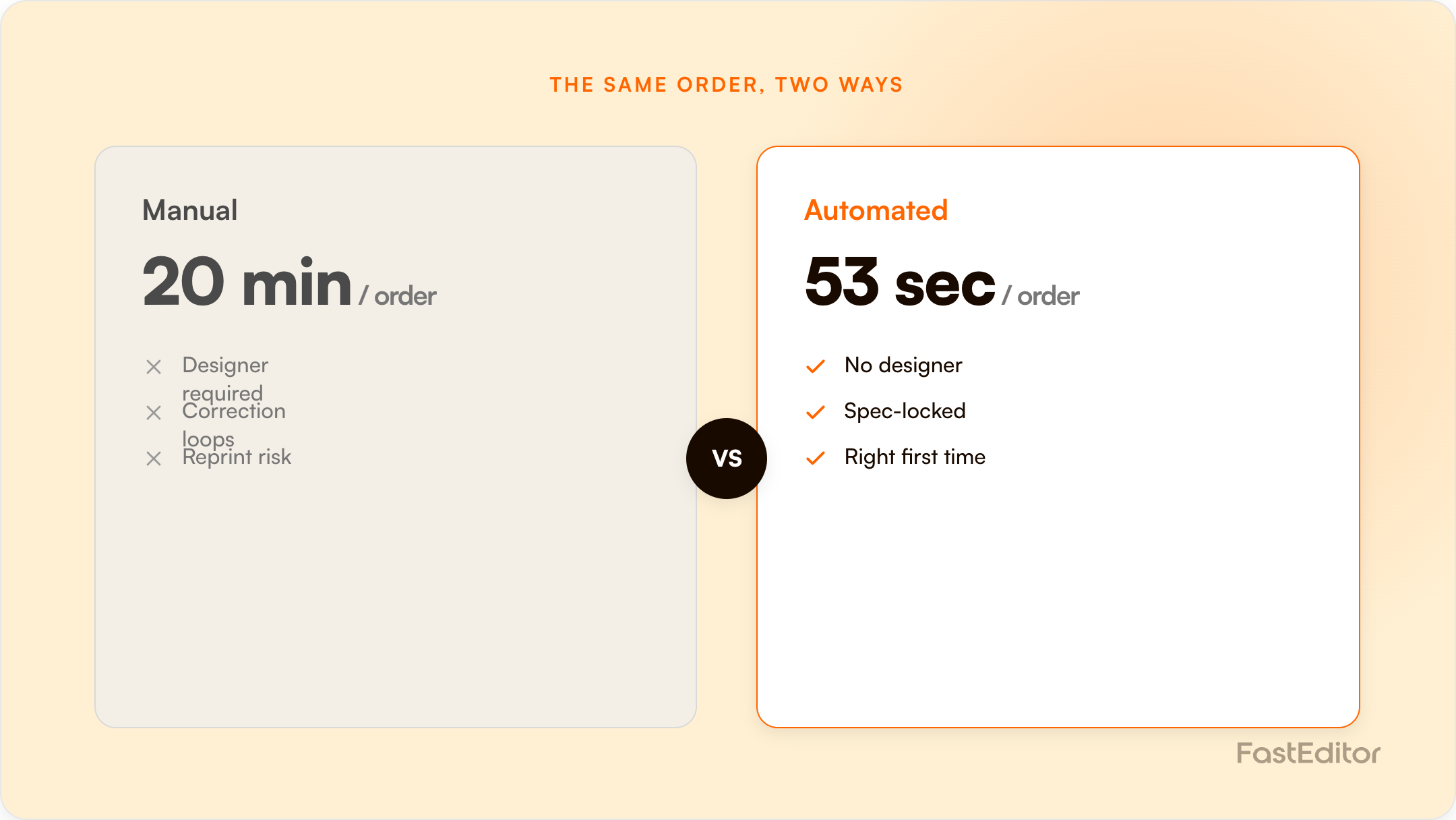
Manual artwork preparation takes about 30 to 60 minutes of skilled time per order, plus a reprint rate near 8%. Modelled conservatively at 30 minutes, 500 orders a month is roughly 250 hours and €9,750 in monthly cost. Automation cuts the artwork cost per order by about 80% and at that volume pays back a €5,000 integration in under three weeks.
FastEditor platform data (March to May 2026): across 13,773 logo uploads, 85% needed at least one automated fix, 61% required vectorisation, 79% required upscaling, and the median time from upload to production-ready file was 53 seconds. These are the real inputs behind the model below. Full data in the Artwork Automation Benchmark 2026.
On this page
Benchmark note: 13,773 logo uploads were analysed in total (19 November 2025 to 31 May 2026). The correction rates quoted here are measured on the stable instrumentation window of 8,664 uploads, March to May 2026. See the full methodology.
Manual artwork handling is the largest cost most promo and print businesses never put a number on. Every order that arrives with a JPEG logo absorbs skilled time: checking the file, vectorising it, building a mockup, chasing a proof, preparing the production file. This article prices every line of that process and compares it with artwork automation, so you can run the same maths with your own volumes.
Across FastEditor's customer integrations, manual artwork preparation takes about 30 to 60 minutes of skilled time per order. That covers file checks, vectorisation, placement, mockups, proofing and production-file preparation. Two further costs ride on top: an error and reprint rate of roughly 8% (our estimate from customer operations, not an industry statistic), and the delay cost of proofs that take hours or days to turn around while the buyer waits.
To price the time, you need an hourly rate. Eurostat puts the average hourly labour cost in the EU at €33.50 in 2024, and skilled design or prepress staff in Western Europe typically cost more once overheads are included. For the model below we assume a fully loaded design cost of €35 per hour. That is an assumption, not a research finding, and you should substitute your own figure. At that rate, 30 to 60 minutes of skilled time is €17.50 to €35.00 of pure labour per order, which sits inside a fully loaded artwork handling cost of about €45 per order once reprints, mockups and unconverted proofs are counted. For a deeper breakdown of the per-order cost, see why artwork handling costs about €45 per order and where promo margin actually goes.
The economics of one manual artwork order
Artwork handling cost
€45
per order, screen print or embroidery
Staff time absorbed
30 to 60 min
across file check, prep, proofing, approval
Proof-to-order conversion
~40%
so 60% of artwork effort never converts
Share that is manual DTP
up to 60%
of the total handling cost
European promotional-products operations. Cost per order rose from about €30 in 2019 to roughly €42 in 2024. The conversion rate, the manual DTP share and these cost-per-order figures are FastEditor operational estimates, not externally published research.
| Cost line | Manual process | Automated process |
|---|---|---|
| Designer time per order | 30 to 60 minutes | About 2 minutes of oversight |
| Labour cost per order (at €35 per hour) | About €17.50 at the conservative 30 minute end of the range | About €1.17 |
| Error and reprint rate | About 8% (operations estimate) | Under 1% with spec-validated files |
| Proofing turnaround | Hours to days | Seconds (53 second median) |
| Software cost | None visible; the cost sits in payroll | Subscription from €95 per month |
| Scaling behaviour | Linear: more orders need more designers | Flat: volume does not add headcount |
All assumptions are labelled as assumptions: 30 minutes of manual artwork time per order, the conservative bottom of the 30 to 60 minute range, 2 minutes of human oversight per order once automated, a fully loaded design cost of €35 per hour, a manual reprint rate of 8% falling to 0.5% with validated files, a direct cost of €25 per reprint, and a platform subscription of €500 per month. FastEditor plans start at €95 per month; we model a higher tier to keep the comparison conservative.
| Monthly cost line | 200 orders | 500 orders | 1,000 orders |
|---|---|---|---|
| Manual labour | €3,500 | €8,750 | €17,500 |
| Manual reprints (8% at €25) | €400 | €1,000 | €2,000 |
| Manual total | €3,900 | €9,750 | €19,500 |
| Automated labour (oversight) | €233 | €583 | €1,167 |
| Automated reprints (0.5% at €25) | €25 | €63 | €125 |
| Software subscription | €500 | €500 | €500 |
| Automated total | €758 | €1,146 | €1,792 |
| Monthly saving | €3,142 | €8,604 | €17,708 |
This is the 250 to 17 hours story in money terms. At 500 orders a month, manual artwork consumes about 250 hours of skilled time; automation reduces the human share to roughly 17 hours of oversight and exception handling, while the engine produces each file in a median of 53 seconds. Across the three volumes, the automated artwork cost per order works out roughly 81 to 91% lower than manual, which brackets the 80% reduction FastEditor customers typically report: the low end of the model lands almost exactly on it, and the gains widen as volume grows.
Integration is the only meaningful one-off cost. A typical FastEditor integration goes live in 3 to 4 weeks; assume €5,000 of internal developer time for the project (again, an assumption to replace with your own rates). Divide that by the monthly savings above and the payback dates fall out directly: about 1.6 months at 200 orders, under three weeks at 500 orders, and about eight days at 1,000 orders. If you are weighing an in-house build instead, the maths changes dramatically; see build vs buy a product configurator.
Cost savings are only half the case. Live, accurate previews remove the biggest source of doubt when buying personalised products. Shopify reports that products with 3D or AR content see an average 94% higher conversion rate than products without. Across FastEditor integrations, storefronts with instant visualisation see about a 20% conversion uplift. On a shop doing €1 million a year, a 20% conversion uplift at the same traffic is roughly €200,000 of additional revenue, which often outweighs the cost savings entirely.
Put your own volumes, rates and conversion assumptions into the FastEditor ROI calculator and you will have a defensible business case in about five minutes.
Helloprint, one of Europe's largest online print platforms, automated artwork across more than 30 product categories with FastEditor and cut artwork processing time by 80%, while holding production accuracy at 99.95%. The pattern matches the model above: the labour line collapses, reprints fall, and the team moves to work that grows revenue rather than processing files. Read the full story in our case studies.
Budget about €45 per order for screen print or embroidery, fully loaded. The labour line is the biggest single piece of that: 30 to 60 minutes of skilled time, or about €17.50 at the conservative 30 minute end of the range and a fully loaded €35 per hour. On top of the labour sit reprints, mockups, proof chasing and the roughly 60% of artwork effort that never converts into an order. Any figure you see that is only a few euros per order is counting hands-on minutes in the artwork file, not the full cycle from file check to approved production file, and complex artwork costs more again.
Under the assumptions in this article, a reseller handling 200 orders a month recovers a €5,000 integration cost in about 1.6 months. At 500 orders a month, payback arrives in under three weeks.
Yes. Shopify reports an average 94% higher conversion rate for products with 3D or AR content, and FastEditor integrations typically see about a 20% conversion uplift.
FastEditor's estimate from customer operations is around 8% of orders. Spec-validated, automated files push that figure under 1%, because errors are caught before production rather than after.
More articles in ROI & Business Case.
