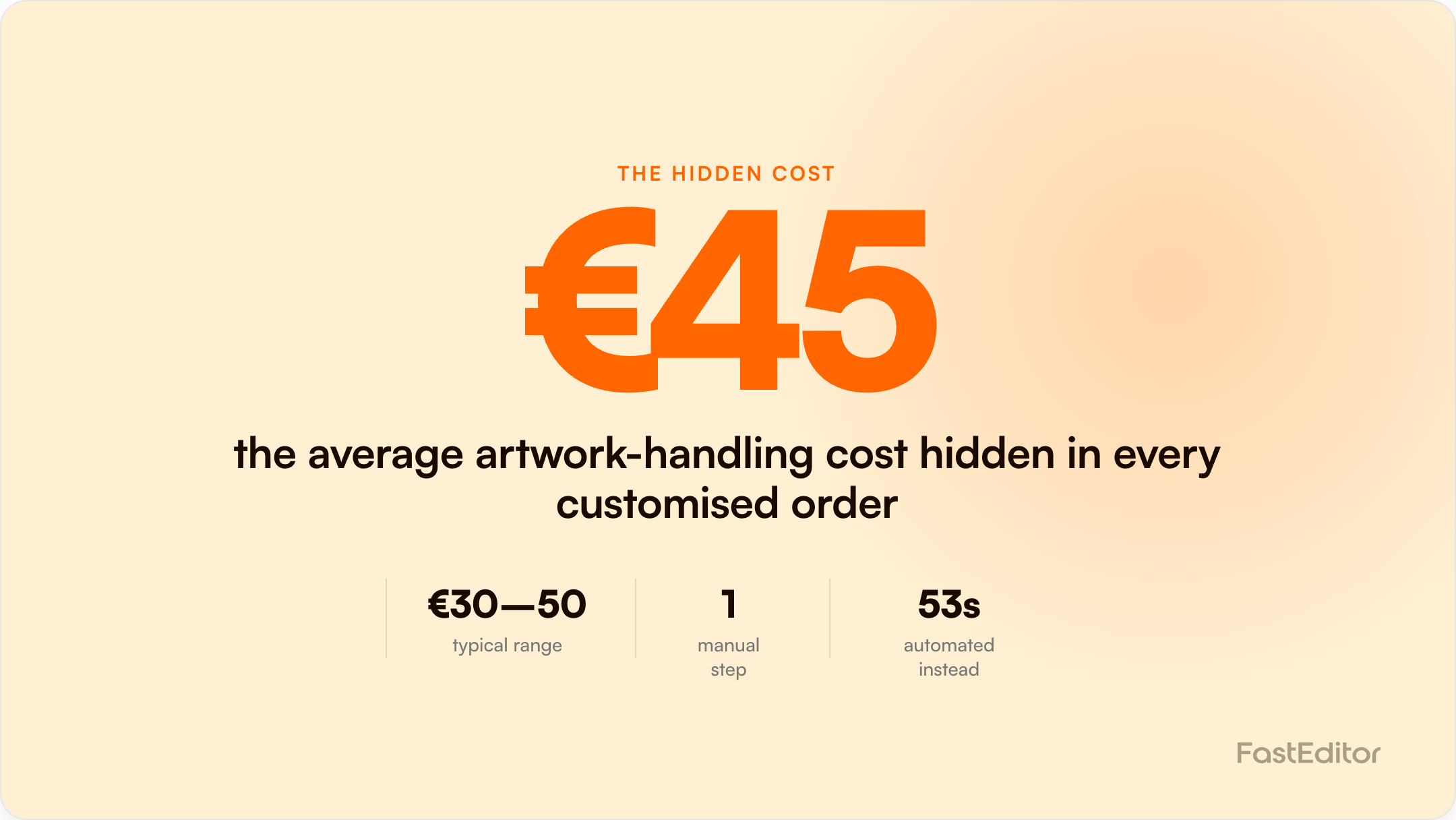
Artwork handling costs a European promo distributor €30 to €50 per order, around €45 for screen print and embroidery. The money goes to file checks, designer prep, proof creation, email revisions, and production-file prep. Because only about 40% of proofs convert to orders, the cost of unconverted work loads onto the orders that do close.
A customer orders 150 printed tote bags. The selling price looks healthy, the margin on paper looks fine, and then the order disappears into the artwork queue. A designer checks the file, finds it is a low-resolution JPEG, rebuilds it, creates a proof, emails it, waits, makes two changes, emails again, gets approval, and prepares the production file. By the time the bags reach production, the order has quietly consumed €45 in internal handling cost that never appeared on any quote.
On this page
That €45 is not a guess. It is the operational reality of customised promotional products in Europe, and it is the single most overlooked number in the industry.
Across European promo and merchandise printing, the operational cost of handling a single order runs between €30 and €50, compared with $25 to $40 in the United States. The figure depends almost entirely on the decoration method, because each method carries a different amount of manual pre-press work.
| Decoration technique | Operational cost per order (Europe) |
|---|---|
| Digital printing, sublimation, digital transfer | €30 |
| Pad printing, debossing, engraving | €40 |
| Screen printing, embroidery | €45 |
Screen printing and embroidery sit at the top because they demand vectorization, colour separations, digitizing, and repeated proof checks before anything can be produced. And this cost is not static. The average operational cost per order in Europe rose from about €30 in 2019 to roughly €42 in 2024, an increase of around 40% in five years, driven by 15 to 30% wage growth for DTP and customer-service staff and employer contributions that add 30 to 50% on top of gross salaries in Western and Northern Europe.
The economics of one manual artwork order
Artwork handling cost
€45
per order, screen print or embroidery
Staff time absorbed
30-60 min
across file check, prep, proofing, approval
Proof-to-order conversion
~40%
so 60% of artwork effort never converts
Share that is manual DTP
up to 60%
of the total handling cost
The cost, conversion, and staff-time figures on this page are FastEditor operational estimates drawn from customer implementations, not externally published research. Cost per order rose from about €30 in 2019 to roughly €42 in 2024.
A single order typically absorbs 30 to 60 minutes of collective staff time before it reaches production, spread across several roles. At a blended €35 per hour, that is roughly €17.50 to €35 of direct labour; the €45 below is the fully loaded figure, which also carries software, overhead, and the share of employer contributions that sits on top of gross salaries. The breakdown is a worked allocation of a €45 screen-print order, anchored to that staff-time figure and to the fact that manual DTP work accounts for up to 60% of total handling overhead.
| Step | What happens | Cost |
|---|---|---|
| Artwork intake and file check | Receiving the upload, checking format, resolution, and colours | €4 |
| Designer prep, vectorization, cleanup | Rebuilding the logo to production quality | €15 |
| Proof creation | Placing artwork on the product and rendering a proof | €8 |
| Email and revision rounds | Sending, waiting, correcting, resending | €9 |
| Approval and handoff | Confirming sign-off and routing to production | €4 |
| Production file preparation | Generating the final print-ready file | €5 |
| Total | €45 |
The pattern is consistent: the work concentrated around the designer, the proof, and the production file accounts for roughly two-thirds of the cost. That is the DTP layer, and it is exactly the part that does not scale. Whether the order is for 25 units or 500, the artwork is checked, fixed, proofed, and prepared once, at almost identical cost. That flat cost behaves very differently depending on quantity, which is why small orders are often less profitable than they look, and it is the single biggest reason margin quietly disappears on a promotional order.
The €45 understates the true burden, because not every proof becomes an order. Industry-wide, the primary proof-to-order conversion rate sits at around 40%. That means roughly 60% of all artwork effort is sunk into quotes and proofs that never close. The handling cost of those unconverted proofs does not disappear. It loads onto the orders that do convert, pushing the effective cost per won order well above the €45 headline.
This is why the artwork queue is so corrosive to margin. It is a cost centre that runs whether or not a sale happens, and it grows in lockstep with quoting activity rather than revenue.
If customers uploaded clean, production-ready files, most of this cost would vanish. They do not. FastEditor platform data from 13,773 logo uploads shows that about 85% of uploaded logos are not production-ready: 61% need vectorization, 79% need upscaling for production quality, and 40% need background removal. Each of those issues is a manual task in a traditional workflow, and each one is a line in the €45.
European handling costs run consistently higher than US costs for structural reasons: higher labour costs and employer obligations, slower adoption of automation, more proofing rounds and stricter client approval expectations, a fragmented supplier and distributor landscape, and the language, cultural, and regulatory diversity of selling across many countries. Within Europe the gap is wide too, from €25 to €35 per order in Eastern and Central Europe up to €42 to €55 in the Nordics.
Almost every line in the breakdown is automatable. When artwork is analysed at the point of upload and corrected automatically, the designer-prep, proof-creation, and revision lines collapse. The FastEditor Logo Editor lets customers fix and approve their own artwork online, cutting the cost of small orders by 20 to 30% and removing up to 80% of manual proofing steps, while the Studio Tool generates a proof and a production-ready file in about 30 seconds, and you can run artwork file prep on its own. The benchmark median from upload to production-ready file is 53 seconds. You can size the saving for your own volumes with the ROI calculator, or see the full picture in our manual-versus-automated ROI comparison.
More articles in ROI & Business Case.
Between €30 and €50 per order in Europe, depending on decoration method. Screen printing and embroidery cost around €45 because they require vectorization, colour separations, and digitizing, while digital print and sublimation sit nearer €30.
Because it is manual. A single order absorbs 30 to 60 minutes of staff time across file checking, designer prep, proof creation, email revisions, approval, and production-file preparation. Manual DTP work alone accounts for up to 60% of the cost.
European operational cost per order climbed from about €30 in 2019 to roughly €42 in 2024, driven by 15 to 30% wage increases for DTP and customer-service staff, employer contributions of 30 to 50% on top of salaries, and labour shortages.
By analysing and correcting artwork automatically at the point of upload, automation removes the designer-prep, proof-creation, and revision steps. This cuts the cost of small orders by 20 to 30% and removes up to 80% of manual proofing steps.
Benchmark note: 13,773 logo uploads were analysed in total (19 November 2025 to 31 May 2026). The correction rates quoted here are measured on the stable instrumentation window of 8,664 uploads, March to May 2026. See the full methodology.
