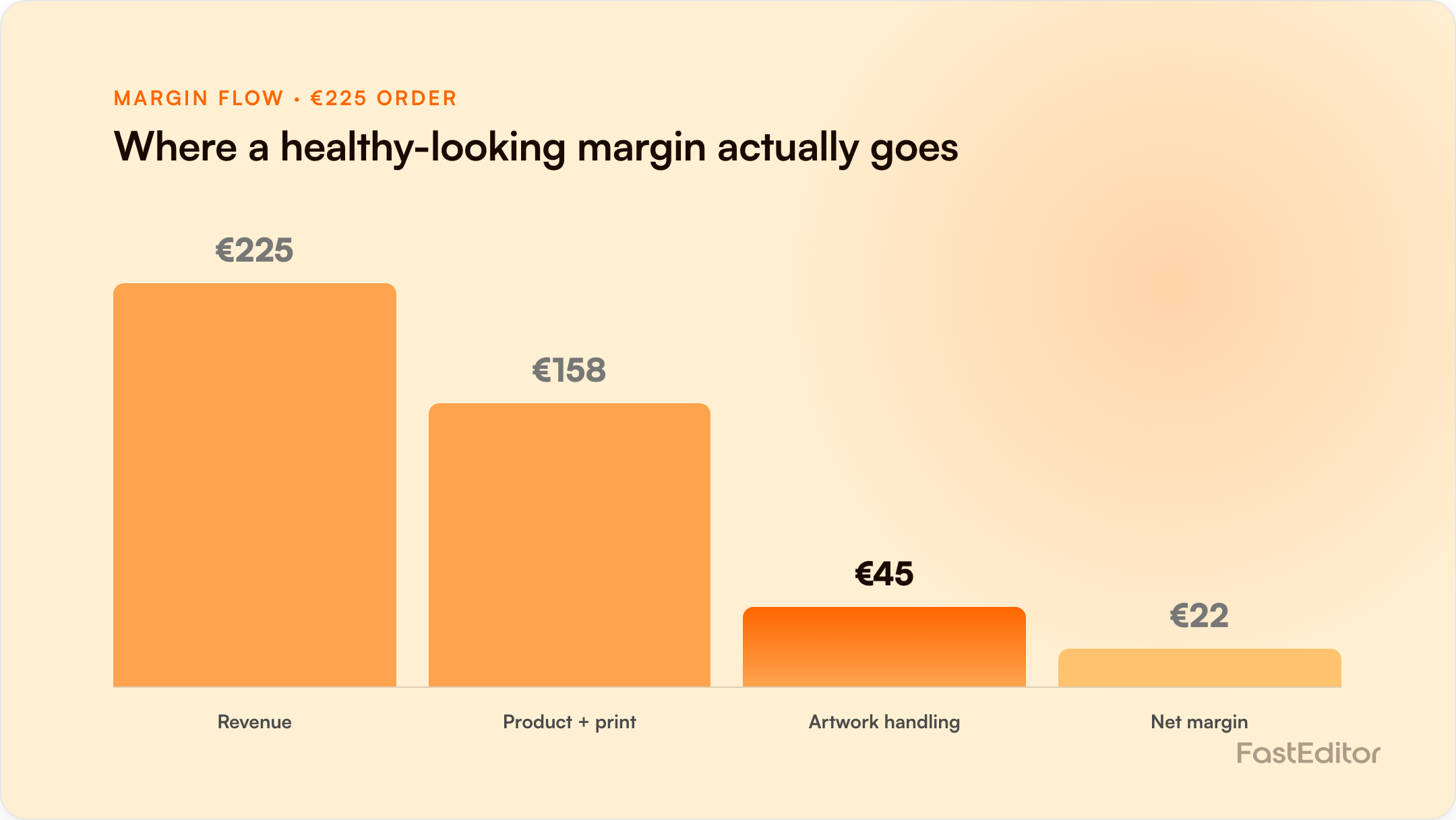
On a typical €225 promotional order, a 30% gross margin gives a €67.50 margin pool. Artwork handling of €45 consumes about two-thirds of it, leaving €22.50 and cutting the effective margin to roughly 10%. Artwork, not product or shipping, is where promo margin quietly disappears.
Here is an order most distributors would happily take: 150 hard promotional items at €1.50 each, €225 in revenue, with a comfortable 30% gross margin. On the quote, it looks like a clean €67.50 of margin. By the time the order ships, most of that margin is gone, and the reason is not the product cost or the shipping. It is the artwork.
Margin in promotional products does not leak evenly. It disappears in one specific place, and almost nobody puts a number on it.
Start with the headline figures on a typical hard-promo order:
That €67.50 is the margin pool: the money left after the cost of the product itself and shipping, and the pool that has to cover everything else and still leave a profit. The problem is what comes out of it next.
The economics of one manual artwork order
Artwork handling cost
€45
per order, screen print or embroidery
Staff time absorbed
30-60 min
across file check, prep, proofing, approval
Proof-to-order conversion
~40%
so 60% of artwork effort never converts
Share that is manual DTP
up to 60%
of the total handling cost
The cost, conversion, and staff-time figures on this page are FastEditor operational estimates drawn from customer implementations, not externally published research. Cost per order rose from about €30 in 2019 to roughly €42 in 2024.
A single customised order carries about €45 of artwork handling cost: file checks, designer prep, vectorization, proof creation, email revisions, approval, and production-file preparation. That is the fully loaded figure. The 30 to 60 minutes of staff time behind it is roughly €17.50 to €35 of direct labour at a blended €35 per hour, with software and overhead making up the rest. Subtract the €45 from the pool and the picture changes completely.
| Line | Amount |
|---|---|
| Revenue | €225.00 |
| Gross margin pool (30%) | €67.50 |
| Artwork handling cost | − €45.00 |
| Remaining margin | €22.50 |
| Effective margin | 10% |
Artwork handling consumes about 66% of the margin pool. The order that looked like a 30% earner is really a 10% earner, and the difference did not go to the customer, the supplier, or the carrier. It went to internal artwork labour that never appeared on the quote. For a deeper look at how that €45 is built up step by step, see why artwork handling costs €45 per order.
Product cost and shipping are visible, quoted, and largely fixed. Everyone tracks them. Artwork handling is invisible: it sits inside salaried DTP and customer-service time, it is rarely allocated per order, and it does not show up in the gross-margin calculation at all. That is exactly why it is dangerous. You cannot manage a cost you never measure, and this is the largest unmanaged cost in the chain. Manual DTP work alone accounts for up to 60% of total operational overhead per order.
One order losing €45 of margin is an annoyance. The same loss at scale is a structural problem. Across an ecosystem processing 100,000 similar orders a year, artwork handling represents €45 multiplied by 100,000, which is €4.5 million in annual artwork cost. A 25% efficiency improvement on that figure protects €1.125 million of margin every year. That is not an incremental saving. It is structural EBITDA impact, and it is why artwork automation is increasingly treated as a P&L decision rather than an operational detail. It is also why leading companies now run two separate operating models, one for high-volume automated orders and one for high-value expert work.
You cannot easily change product cost, and shipping is what it is. Artwork handling is the one large cost in the order that is almost entirely addressable, because most of it is repetitive manual work. When customers correct and approve their own artwork at the point of upload, the designer-prep, proof, and revision lines shrink or disappear. The FastEditor Logo Editor cuts the cost of small orders by 20 to 30% and removes up to 80% of manual proofing steps, and the Studio Tool produces a proof and a production-ready file in about 30 seconds. The reason the file needs so much work in the first place is simple: platform data from 13,773 logo uploads shows about 85% are not production-ready. The damage is worst on small runs, where the same €45 can erase the order entirely. Recover that handling cost and the €22.50 order moves back toward the €67.50 it was supposed to be. You can model the margin recovery for your own order mix with the ROI calculator. To weigh the cost of automating that work, see how per-file artwork automation pricing works.
More articles in ROI & Business Case.
Mostly into artwork handling. On a €225 order with a 30% gross margin, the €67.50 margin pool is reduced by about €45 of artwork handling cost, leaving roughly €22.50 and an effective margin near 10%.
About two-thirds. At €45 of handling against a €67.50 margin pool, artwork consumes roughly 66% of the margin available on the order.
Because it sits inside salaried DTP and customer-service time and is rarely allocated per order. Gross margin typically captures only product cost and shipping, so the largest variable cost stays hidden.
Automating artwork at the point of upload cuts the cost of small orders by 20 to 30% and removes up to 80% of manual proofing steps. Across 100,000 orders, a 25% efficiency gain protects about €1.125 million in margin per year.
Benchmark note: 13,773 logo uploads were analysed in total (19 November 2025 to 31 May 2026). The correction rates quoted here are measured on the stable instrumentation window of 8,664 uploads, March to May 2026. See the full methodology.
