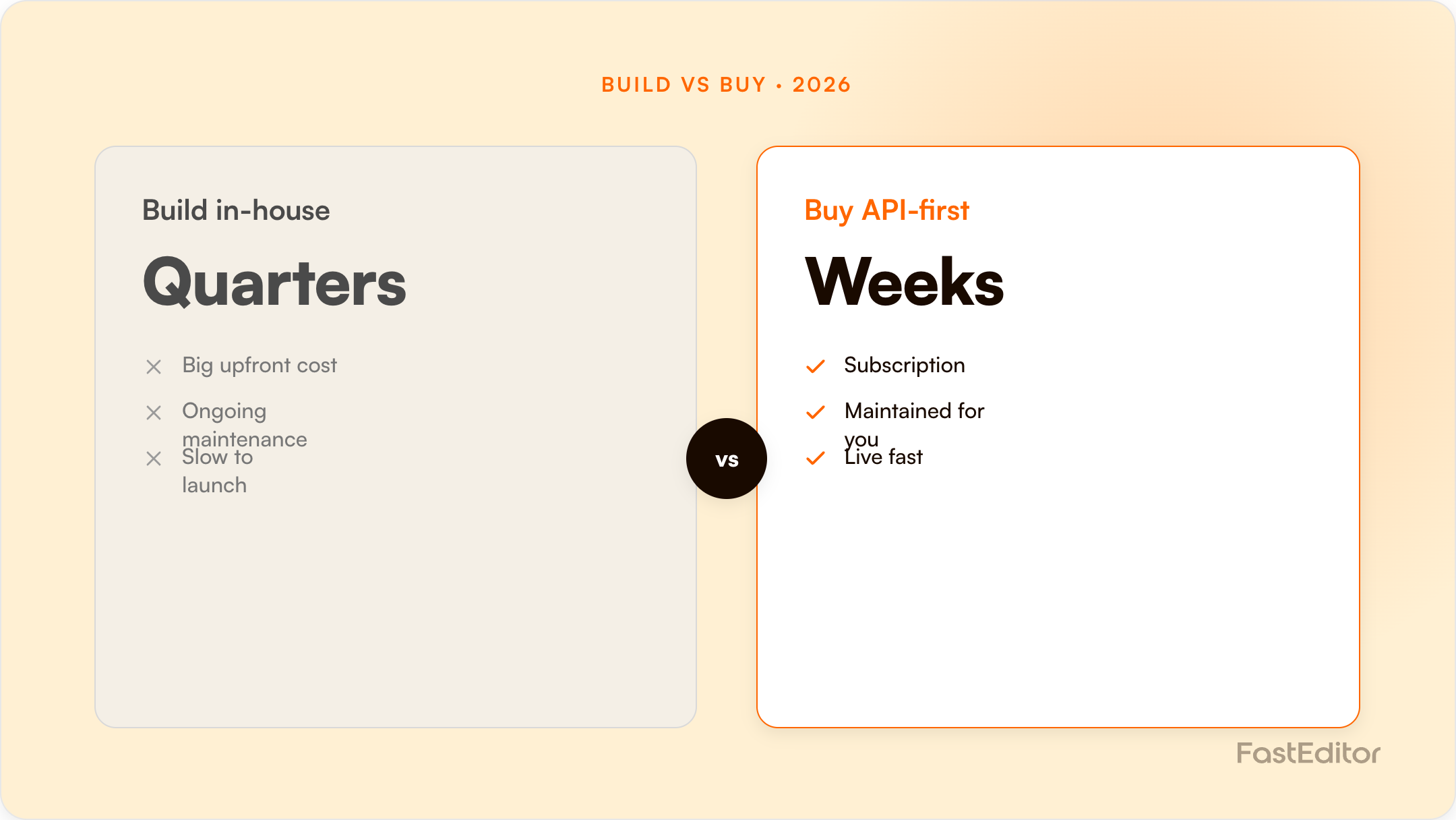
Building a production-grade configurator in-house typically takes 6 to 12 months and a three year TCO near €282,500 under our labelled assumptions. Buying an API-first platform costs about €26,000 over the same period and goes live in 3 to 4 weeks. Build only when the configurator is your core product.
FastEditor platform data (March to May 2026): a bought, API-first engine handled 13,773 logo uploads, auto-corrected the 85% that needed at least one fix, vectorised 61%, upscaled 79%, and delivered production-ready files in a median of 53 seconds. That is the capability you would otherwise build and maintain yourself. See the Artwork Automation Benchmark 2026.
On this page
Benchmark note: 13,773 logo uploads were analysed in total (19 November 2025 to 31 May 2026). The correction rates quoted here are measured on the stable instrumentation window of 8,664 uploads, March to May 2026. See the full methodology.
"We will just build it ourselves." It is a tempting line for any team with developers, and sometimes it is even right. But a product configurator that generates real production files is not a feature, it is a platform: a vectorisation engine, a supplier spec database, a rendering pipeline and a file generator, all running behind one upload button. (A configurator and an artwork-automation layer are not the same thing, a distinction worth grasping before you price either path.) This article puts a three year price on both paths, lists the costs build quotes always miss, and ends with the cases where building genuinely wins.
A demo configurator that overlays a PNG on a product photo takes a sprint. A production configurator has to cope with what customers really upload. In FastEditor's benchmark data, 85% of real logo uploads needed at least one automated fix before they could be printed: 61% needed vectorisation and 79% needed upscaling. Handling that automatically means building, at minimum:
Each of those is a product in its own right. Most build estimates price the first demo, not the four subsystems behind it.
Assumptions, labelled as assumptions: a build team of three full-time engineers for nine months at a fully loaded €7,500 per engineer per month, a discovery phase of €20,000, and post-launch maintenance at 15 to 20% of the build cost per year, a common industry rule of thumb. For context on rates, Stack Overflow's 2025 Developer Survey reports average full-stack developer pay in the US around $138,000 before overheads, and ScienceSoft notes that maintenance can reach up to 90% of a system's total cost of ownership over its life. On the buy side we assume a €500 per month subscription (FastEditor plans start at €95 per month) and €8,000 of internal integration effort.
| Cost line (3 years) | Build in-house | Buy API-first |
|---|---|---|
| Discovery and specification | €20,000 (assumption) | Included in onboarding |
| Initial build or integration | About €202,500 (3 engineers, 9 months) | About €8,000 (3 to 4 weeks of internal effort) |
| Time to first live order | 6 to 12 months | 3 to 4 weeks |
| Maintenance, years 2 and 3 | About €60,000 (15 to 20% of build per year) | Included in subscription |
| Subscription, 36 months | None | About €18,000 (€500 per month assumed) |
| Supplier spec upkeep | Your engineers, indefinitely | Vendor maintained across 150+ suppliers |
| Three year total | About €282,500 | About €26,000 |
Under these assumptions the gap is roughly tenfold, and the build column starts paying out six to twelve months before it earns anything. Adjust every input to your own rates; the order of magnitude rarely changes, because the build side carries people and the buy side carries a subscription. The cost the whole exercise exists to remove, the €45 it costs to handle one order's artwork manually, only starts falling once you are live.
Build when the configurator is your core product and differentiator, not supporting infrastructure. Build when your product types are so unusual that no platform covers them. Build when you have a standing platform team and a multi-year budget that treats maintenance as a feature, not a tax. If those three are true, the TCO comparison above is the cost of owning your moat, and it can be worth paying. For everyone else selling personalised products, it is an expensive way to recreate something that exists, as the web-to-print buyer's guide shows in vendor terms.
An API-first platform ships with the hard parts solved: 563,981 ready product configurations built on real supplier specs, automated vectorisation and file generation, and a web-to-print API that rolls out across a full catalogue without per-product development. Helloprint took this route and cut artwork processing time by 80% across more than 30 product categories; the full story is in our case studies. Typical integrations go live in 3 to 4 weeks. That same API-first property is also what lets one configuration reach every channel you sell through instead of just one storefront; see what API-first actually means for a product configurator.
Under the labelled assumptions in this article, building costs about €282,500 over three years against about €26,000 for buying an API-first platform. The exact gap depends on your rates, but maintenance and supplier spec upkeep keep the build side expensive long after launch.
A production-grade MVP typically takes 6 to 12 months with a small dedicated team, and the work does not end at launch: specs, decoration methods and edge cases need permanent ownership.
A common industry rule of thumb is 15 to 20% of the original build cost per year, and analysts note maintenance can reach the large majority of a system's lifetime cost of ownership.
When the configurator is your core product and differentiator, when your product types are not covered by any platform, or when constraints rule out third party infrastructure and you hold a multi-year engineering budget.
If you are actively comparing vendors, we keep honest side-by-side write-ups of the main alternatives: Zakeke, Customily, Printess, Kickflip, ImprintNext and Design'N'Buy / PrintXpand, or browse them all in Comparisons.
More articles in ROI & Business Case.
