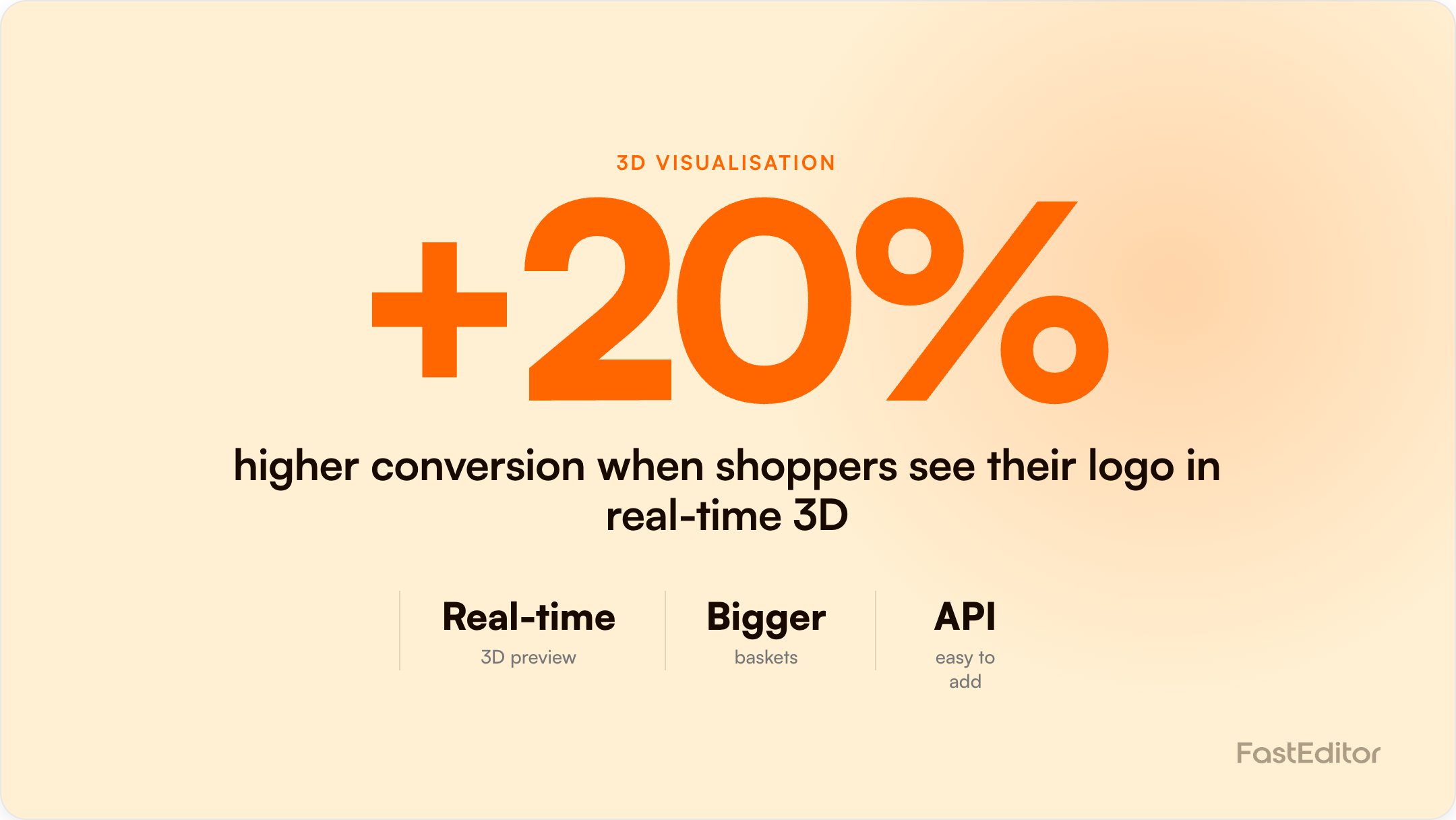
Real-time 3D visualisation lets customers see their logo on the actual product shape before buying. Across FastEditor integrations it lifts conversion by around 20%, and independent research from Shopify and Deloitte points the same way, often more strongly.
Here is the claim, stated plainly: across FastEditor integrations, product pages with real-time 3D visualisation convert around 20% better than pages with flat 2D mockups. That is a FastEditor integration figure, measured on live promotional product stores, not independent research. But the independent research points in the same direction, and often more strongly.
On this page
The most cited figure comes from Shopify, which reports that merchants who add 3D content to product pages see an average 94% increase in conversions compared with products shown in flat images only. A 2021 Deloitte Digital study commissioned by Snap Inc reached a near identical conclusion for augmented reality: interacting with products that have AR experiences leads to a 94% higher conversion rate, and more than 100 million consumers already shop with AR online and in stores. Product visualisation platform Threekit adds a willingness-to-pay angle: 40% of customers say they would pay more for a product they can experience through AR first.
Why is FastEditor's 20% figure so much lower than the 94% headlines? Because the baselines differ. Those studies compare 3D against static photos of generic products. Promotional product stores already show some form of logo preview, so the realistic comparison is 2D mockup versus real-time 3D, a smaller but still decisive gap. We would rather publish a conservative number we can stand behind than borrow a dramatic one from a different context.
Personalised products carry asymmetric risk. A buyer who orders 500 mugs with a slightly wrong logo placement cannot return them. So buyers hesitate, request manual proofs, email PDFs back and forth, or simply abandon the basket. Every open question, such as how the logo curves around the mug or whether white text survives on a navy polo, is a reason to wait. Real-time 3D answers those questions in the moment, on the product page, before doubt becomes abandonment. It does for personalised goods what instant print proofs do for the ordering workflow: it removes the wait where deals die.
The second mechanism is psychological ownership. Behavioural research on the endowment effect shows that people value things more once they feel the item is theirs, and that feeling starts before purchase. A customer who rotates a bottle carrying their own logo, zooms into the engraving, and views it from three angles has mentally taken possession of it. A generic flat overlay never triggers that shift. This is why interaction matters as much as image quality: the act of manipulating the product builds commitment. The same effect works across a meeting table, which is the case for using the logo editor as a live sales tool.
| Dimension | 2D flat mockup | Real-time 3D |
|---|---|---|
| What the customer sees | Logo pasted on a flat photo | Logo wrapped on the true product geometry |
| Curved surfaces | Distortion guessed or ignored | Rendered accurately around the curve |
| Decoration method | Generic overlay | Method-accurate: embroidery thread, screen print, laser engraving |
| Interaction | Static image | Rotate, zoom, multi-angle |
| Buyer confidence | Must imagine the result | Sees the result |
| Measured impact | Baseline | Around +20% conversion across FastEditor integrations |
Mugs, bottles, pens and powerbanks are where 2D mockups fail hardest. A flat logo overlay on a cylindrical surface is simply wrong, and buyers sense it even when they cannot articulate why. 3D wraps the artwork around the real geometry, so the preview matches the delivery.
Embroidery is the classic trust gap. Thread has direction, sheen and stitch density that no flat mockup conveys. A method-accurate 3D render that simulates thread on fabric is the difference between a buyer ordering 200 polos online and a buyer phoning to ask for a physical sample.
Laser engraving on metal or wood changes the material rather than adding ink. Showing that effect convincingly requires lighting and texture simulation, which is exactly what real-time 3D rendering does and a Photoshop overlay does not.
Conversion is only half the story. When buyers trust the preview, they configure more: extra colours, second placement positions, additional products in the same order. Across FastEditor integrations, that tends to show up as a larger average basket once 3D visualisation is live. Pairing the preview with automated recommendations compounds it: the FastEditor cross-sell module shows 23% higher basket value and a 120% higher cross-sell probability across integrations, because a customer who has just seen their logo on a mug is highly receptive to seeing it on a notebook too. This is one of the trends reshaping the category, as covered in the future of personalised promo products.
The reason most resellers and suppliers have not deployed 3D is cost: photographing or modelling every product, every colourway, every print area is a programme of work nobody budgets for. The practical path is to embed an existing engine via API. FastEditor's 3D visualisation connects to the Product Hub, a library of more than 563,981 ready product configurations covering 150+ suppliers, so the models, print areas and decoration methods already exist. Your storefront sends the product ID and the customer's logo; the engine returns an interactive, method-accurate preview.
The quality of that preview depends on the quality of the artwork going in, which is why 3D works best on top of artwork automation. FastEditor's 2026 benchmark of 13,773 real logo uploads found that 85% of customer logos need at least one automated fix, 61% need vectorisation, and the median time from upload to production-ready file is 53 seconds. Clean the file first, then render it in 3D, and the preview the customer approves is the file production receives. The same rendered product can be dropped into styled mood scene mockups to lift conversion further up the funnel. That pipeline is also how teams scale order volume without hiring designers.
See it on your own products. The 3D visualisation page shows live examples of method-accurate previews and explains the API embed, with integrations typically live in weeks rather than quarters.
Before a product can appear in 3D, its data has to support it: see what makes a catalogue 3D-ready.
Yes. Shopify reports an average 94% conversion increase for products with 3D content versus flat images, and a Deloitte study commissioned by Snap found a similar effect for AR. Across FastEditor integrations, where the baseline already includes 2D logo previews, the measured uplift is around 20%.
A 2D mockup pastes the logo onto a flat photo and asks the customer to imagine the rest. Real-time 3D wraps the artwork onto the true product geometry, simulates the decoration method, and lets the customer rotate and zoom, so they see the result instead of guessing at it.
No. A product model library such as the FastEditor Product Hub provides more than 563,981 ready configurations across 150+ suppliers, embedded into your storefront via API, so you never model or photograph products yourself.
Curved products such as mugs, bottles and pens, apparel with embroidery, and anything with engraving or material effects. These are the categories where flat mockups are least convincing and buyer uncertainty is highest.
More articles in E-commerce & Conversion.
Benchmark note: 13,773 logo uploads were analysed in total (19 November 2025 to 31 May 2026). The correction rates quoted here are measured on the stable instrumentation window of 8,664 uploads, March to May 2026. See the full methodology.
