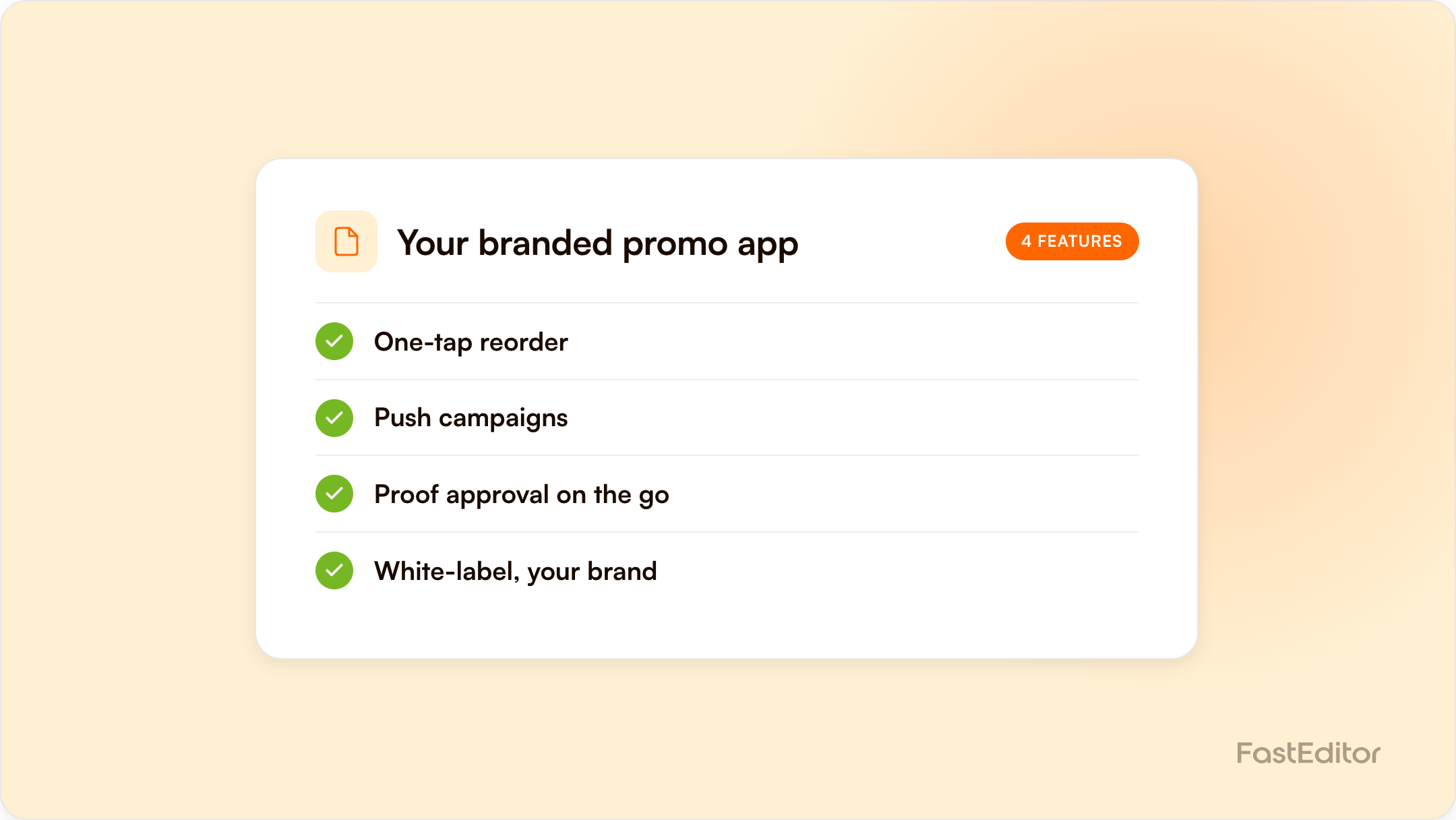
B2B buyers already research and transact on mobile, but promo ordering still assumes a desktop. A white-label branded app brings one-tap reorders, push campaigns and on-the-go proof approvals under your own brand, live in 6 weeks instead of the 6 to 12 months and six-figure budget of a custom build.
Your customers order food, taxis, flights and office supplies from their phones. Then they need 250 branded mugs and suddenly they are expected to find a laptop, dig out a vector file and email a PDF proof back and forth for three days. That gap between how people buy everything else and how they buy promotional products is not a detail. It is one of the clearest open opportunities in the industry.
On this page
The shift is documented well beyond promo. Research by Boston Consulting Group, in partnership with Google, found that mobile already drives or influences more than 40% of revenue in leading B2B organisations, and that engaging buyers on mobile shortens purchase time and increases loyalty. Google's own data showed that half of B2B search queries are made on smartphones, a share BCG expected to keep climbing as younger buyers move into procurement roles. The people ordering your merchandise, typically marketing managers and office managers, are exactly that demographic. They research on the phone, compare on the phone and expect to transact on the phone.
Promotional products are harder to buy on a phone than a train ticket, and the industry has used that as an excuse for a decade. The genuine obstacles were real: ordering requires uploading artwork, judging a proof, and trusting that a logo will survive production. Legacy web-to-print interfaces were built for desktop screens, file pickers and patient users. Reviewing a PDF proof on a 6-inch screen was miserable, so the workflow stayed on the laptop, and mobile traffic to promo stores converted poorly, which then justified not investing in mobile.
Every one of those obstacles has since fallen. Logos now live on phones, in camera rolls, email attachments and cloud drives. Artwork automation fixes broken files on upload: FastEditor's benchmark of 13,773 real logo uploads found 85% need at least one automated fix, and the median time from upload to a production-ready file is 53 seconds, fast enough to happen inside a mobile session. And real-time 3D previews replace the PDF proof with something that is actually better on a touchscreen, a product you can rotate with your thumb. The constraint was never demand. It was tooling.
A branded app is not your website squeezed onto a smaller screen. It changes the commercial relationship in three specific ways.
Most promo revenue is repeat revenue: the same polo shirts for new starters, the same mugs for the next event. On the web, every reorder restarts the journey. In an app, the customer's artwork, approved proofs, sizes and addresses are saved, so a reorder is a tap and a quantity. Removing that friction is how you capture the recurring spend that currently leaks to whichever supplier answered email fastest.
An app icon on the home screen is permanent shelf space, and push notifications are a direct channel that email increasingly is not. Seasonal deadlines, restock reminders for popular items, a nudge when an abandoned design is still waiting: these campaigns reach buyers at near-zero marginal cost, under your brand.
Proof approval is the step where promo orders stall for days. When the proof arrives as a push notification and the customer can review a method-accurate preview and approve it from the sofa, the gap between intent and confirmation collapses from days to minutes. The same logic that makes a 30-second print proof valuable on the web is amplified on mobile, because the phone is always there.
All of this only builds your business if the app carries your brand. White-label means the app store listing, icon, colours and name are yours; the vendor's technology is invisible. Your customers' loyalty, reorder behaviour and push-notification permission accrue to you, not to a third-party marketplace that may one day compete with you. Under the surface, the app runs on the same Product Hub catalogue and artwork automation flow as your web store, so products, prices and artwork stay in sync across channels.
Industry surveys consistently put custom enterprise app development in the $100,000 to $500,000 range, with a Clutch survey of development agencies finding a median of around $171,450 per app. A commerce app with logo upload, live visualisation and production-file output sits at the complex end, so a typical custom build budget of €150,000 or more before maintenance is a realistic planning figure, not a scare number.
| Factor | Custom build | White-label platform |
|---|---|---|
| Upfront cost | Typically €150,000+ for a full commerce app, based on industry survey ranges | Platform subscription, no build budget |
| Time to launch | 6 to 12 months | Live in 6 weeks with FastEditor's white-label app |
| Artwork engine | Build or license separately | Included: upload, fixing, visualisation, production files |
| Product catalogue | Manual integration per supplier | Product Hub: 563,981 configurations, 150+ suppliers |
| Maintenance and OS updates | Your team, typically 15 to 25% of build cost per year | Included in the platform |
| Risk if it underperforms | Sunk six-figure cost | Subscription you can stop |
For resellers, the app slots into the same commercial logic as the rest of the stack, covered in our guide for e-commerce resellers, and it is one of the five shifts described in the future of personalised promo products.
See what your own app would look like. The FastEditor white-label mobile app page walks through the features, the branding options and the 6-week launch process.
Yours. White-label means your logo, colours, name and app store listing. Customers experience your business; the platform underneath is invisible to them.
Yes. Browsing, logo upload, automated artwork fixing, real-time visualisation, ordering and order tracking all run natively on iOS and Android, powered by the same catalogue and artwork engine as your web store.
Industry surveys put custom enterprise app development between $100,000 and $500,000, with a median around $171,450, plus ongoing maintenance. A white-label app replaces that with a platform subscription and no build project.
FastEditor's white-label app is typically live in 6 weeks, covering branding, catalogue setup, a customer pilot and app store approval. A comparable custom build usually takes 6 to 12 months.
A branded app is one channel for repeat orders; the wider model is covered in our guide to running branded company stores at scale.
More articles in E-commerce & Conversion.
Benchmark note: 13,773 logo uploads were analysed in total (19 November 2025 to 31 May 2026). The correction rates quoted here are measured on the stable instrumentation window of 8,664 uploads, March to May 2026. See the full methodology.
