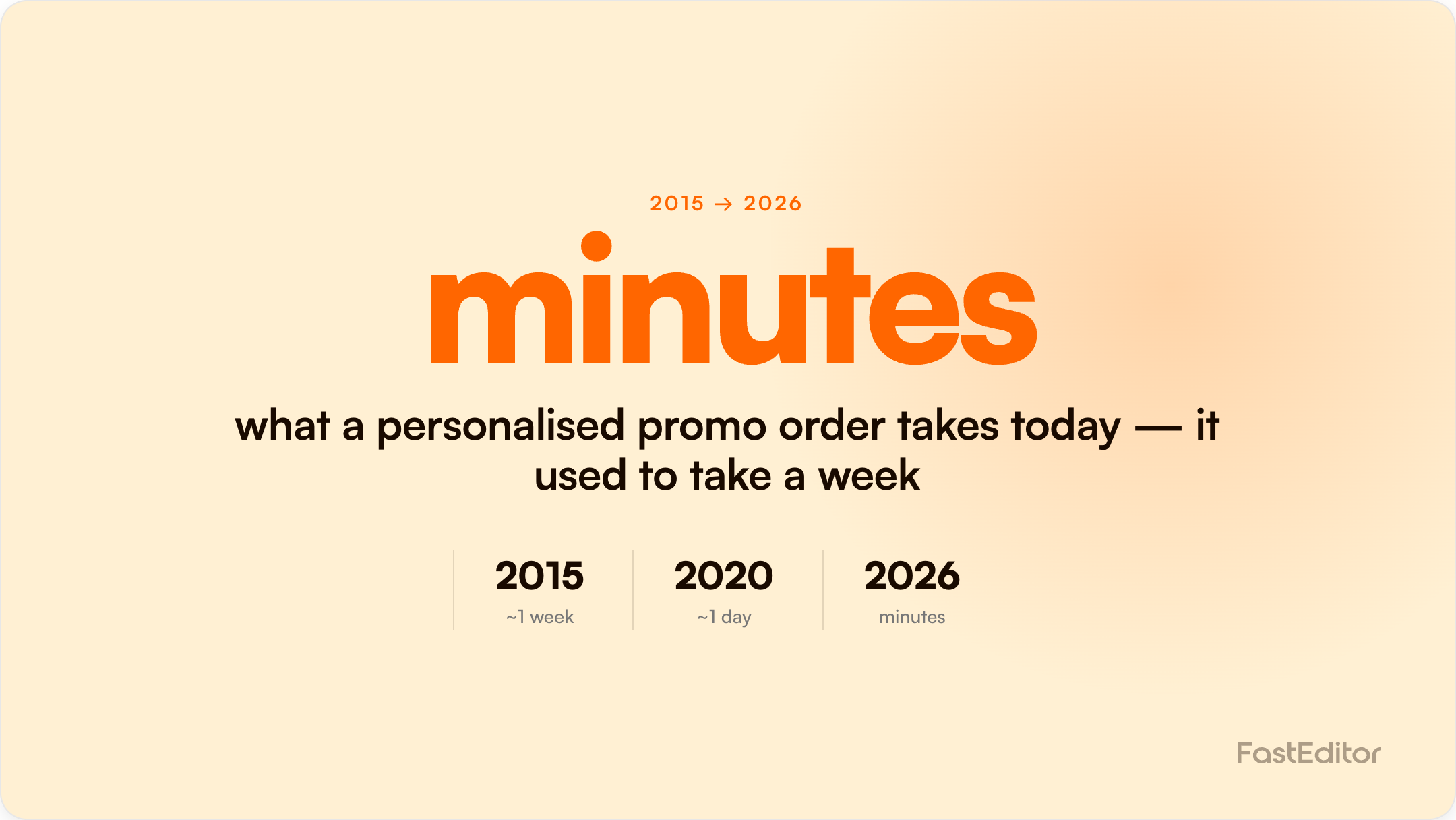
Promo ordering went from a week in 2015 to minutes in 2026 because the artwork layer was automated. Five trends now build on that shift: instant artwork automation, 3D previews as default, AI in production workflows, mobile ordering and supplier network distribution, each backed by a verifiable data point.
In 2015, a personalised promo order took about a week: catalogue, quote, artwork emails, proof cycles, prepress. In 2026, the same order takes minutes. Nothing about the products changed. What changed is that the artwork and operations layer between a buyer's logo and a production file was automated, and every trend worth watching in this industry flows from that one shift. This piece maps where ordering came from, and the five trends that will define what happens next, each with a driver, a verifiable data point and a concrete action.
On this page
| Stage | 2015 | 2026 |
|---|---|---|
| Finding the product | Printed catalogue and a sales rep visit | Self-serve online catalogue, web and mobile |
| Supplying artwork | Email a logo, wait for a designer to ask for a vector file | Upload any file; automated fixing in seconds |
| Seeing the result | Flat mockup emailed back days later | Real-time 3D preview in the same session |
| Proof approval | PDF proof by email, 2 to 5 days of revision cycles | On-screen approval at the moment of ordering |
| Production file | Manual prepress and a second QA check | Generated automatically to supplier spec |
| Minimum order | High MOQs to justify the manual setup cost | Low or single-unit orders commercially viable |
| Total elapsed time | Around a week | Minutes |
With that gap as context, here are the five trends that matter, without the hype.
The driver: buyers trained by consumer e-commerce will not wait days for a proof, and the economics of manual prep collapse as average order sizes shrink.
The data: FastEditor's 2026 benchmark of 13,773 real logo uploads shows why this cannot be solved with effort alone: 85% of customer logos need at least one fix before production, 61% need vectorisation and 79% need upscaling. Automated, the median time from upload to a production-ready file is 53 seconds. Manually, each of those fixes is an email thread.
What to do: treat artwork automation as infrastructure, not a feature. Automate file intake first, because it is the step that blocks everything downstream, then proofs, then production files.
The driver: uncertainty is the main reason personalised baskets get abandoned, and interactive previews remove it at the moment of decision.
The data: Shopify reports that merchants adding 3D content to product pages see an average 94% increase in conversions versus flat images. In promo specifically, where some preview already exists, the gap is smaller but still decisive: across FastEditor integrations, real-time 3D lifts conversion by around 20% and basket size by around 25%. The full evidence and psychology are in our piece on 3D visualisation and promo conversion.
What to do: prioritise 3D for the categories where flat mockups fail hardest: curved products, embroidered apparel and engraving. Embed an existing engine via API rather than commissioning models product by product.
The driver: the first wave of AI in promo wrote product descriptions. The second wave is operational: file repair, colour matching, print-area validation and prepress, where errors cost real money in reprints.
The data: this is no longer speculative. In a November 2025 PPAI survey, 25.5% of PPAI 100 suppliers had already integrated AI into their workflows and another 41.8% were actively testing it, meaning two thirds of the industry's largest suppliers are past the curiosity stage. The breakdown is in our analysis of AI in the promo industry.
What to do: apply AI where output is measurable and failure is visible, such as artwork repair and production files, and demand accuracy figures from vendors. Across FastEditor integrations, automated production files reach 99.95% output accuracy; any serious supplier should be able to quote an equivalent number.
The driver: the people who order merchandise are the same people who run their lives from their phones, and the tooling obstacles that kept promo on the desktop, clumsy file uploads and PDF proofs, have been solved.
The data: Boston Consulting Group research with Google found mobile already drives or influences more than 40% of revenue in leading B2B organisations. Promo is one of the last B2B categories where that demand has nowhere to go.
What to do: meet the reorder moment on the phone. A white-label app with saved artwork, push notifications and on-the-go proof approval turns repeat buyers into app users; the case and the rollout playbook are in our guide to branded mobile apps for promo.
The driver: resellers want catalogue breadth without running an integration project per supplier, and suppliers want their products sellable, with accurate print data, in every digital channel at once. Point-to-point integrations cannot scale to that; networks can.
The data: the FastEditor Product Hub now carries more than 563,981 ready product configurations from 150+ suppliers, each with print areas, decoration methods and production specs digitised once and reused by every connected storefront. That is FastEditor network data, but it illustrates the structural point: a supplier who digitises specifications once becomes instantly sellable across an entire reseller network.
What to do: if you are a supplier, treat your product data and print specifications as a sales channel and connect them to a network; the practical steps are in the supplier go-live playbook. If you are a reseller, choose platforms that give you supplier breadth out of the box instead of a queue of integration projects.
None of this is a prediction about 2030. Helloprint cut artwork processing time by 80% across more than 30 product categories, and resellers across the FastEditor network have scaled visualised catalogues and API-generated designs without growing their artwork teams. The pattern is consistent: the winners automated the artwork layer first, then layered 3D, mobile and cross-sell on top of it.
See the 2026 playbook in practice. The FastEditor case studies show how suppliers and resellers implemented these five trends, with the numbers each one achieved.
The artwork layer was the bottleneck: manual vectorisation, email proof cycles and prepress checks. The selling and the production machinery were never the slow part, which is why automating artwork collapsed the timeline from a week to minutes.
Instant artwork automation, because the other four depend on it. 3D previews, mobile ordering and AI workflows all assume the customer's file can be fixed and made production-ready in seconds rather than days.
Real and measurable. A November 2025 PPAI survey found 25.5% of PPAI 100 suppliers had integrated AI into their workflows and 41.8% were actively testing it, so roughly two thirds of the largest suppliers are already committed.
Digitise product data and print specifications once, then connect them to a distribution network so every connected reseller can sell and personalise the catalogue without a bespoke integration project.
More articles in Artwork Automation.
Benchmark note: 13,773 logo uploads were analysed in total (19 November 2025 to 31 May 2026). The correction rates quoted here are measured on the stable instrumentation window of 8,664 uploads, March to May 2026. See the full methodology.
