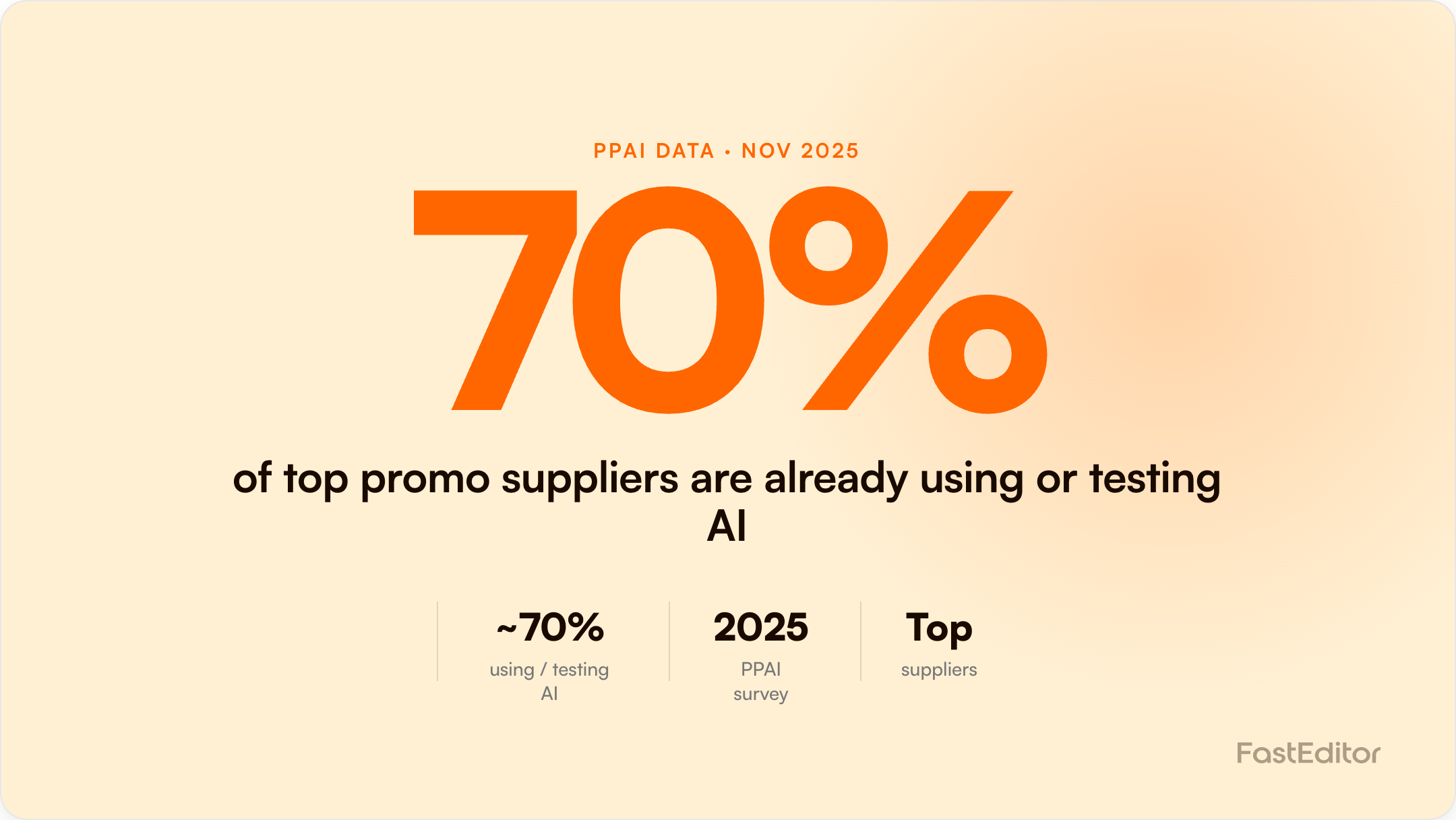
PPAI's November 2025 survey of PPAI 100 suppliers found 25.5% have integrated AI into production and order workflows, 41.8% are testing tools, and only 12.7% have no plans. The clearest returns sit in the production layer, in vectorization, proofing and production-file output, rather than in content generation.
The promotional products industry finally has hard numbers on AI adoption. In November 2025, PPAI Research ran a flash survey of PPAI 100 suppliers, the industry's top-ranked firms, and the findings were unambiguous: 25.5% have already integrated AI into production, order processing or workflow automation, and another 41.8% are actively testing AI tools. Nearly 70% are hands-on with AI today. The question for 2026 is no longer whether the industry will adopt AI. It is where AI actually pays off.
On this page
PPAI's survey, conducted by market economist Alok Bhat for PPAI Research, splits supplier AI adoption into four groups:
PPAI's own conclusion is worth quoting: nearly 70% of PPAI 100 suppliers are already using or testing AI, "signaling a shift toward faster, more automated workflows in 2026". The same report lists automation gains among the most-cited opportunities for 2026, and notes that the few suppliers who protected their margins in 2025 were typically firms with automated workflows or diversified sourcing.
Because AI claims in this industry are often vague, here are the figures that can actually be traced to a named source.
| Finding | Figure | Source |
|---|---|---|
| Top suppliers with AI integrated into production, order processing or workflow automation | 25.5% | PPAI 100 Supplier Sales Insights, Nov 2025 |
| Top suppliers testing AI for design, quoting, forecasting or customer service | 41.8% | PPAI 100 Supplier Sales Insights, Nov 2025 |
| Top suppliers planning adoption within 12 to 18 months | 20.0% | PPAI 100 Supplier Sales Insights, Nov 2025 |
| Extra-large distributors (over $5m revenue) using AI | 50% | ASI Counselor State of the Industry, 2025 |
| US distributors that integrated new technologies (AI, AR, VR) in 2024 | 22% overall; 49% of firms above $2.5m | PPAI 2024 Sales Volume Report |
| Organisations using AI in at least one business function, all industries | 88% | McKinsey, The State of AI, 2025 |
The headline adoption rate hides a split that matters. ASI's 2025 Counselor State of the Industry found that among distributors using AI, the most common application is writing creative copy. That is the content layer: emails, product descriptions, social posts. Useful, but it saves minutes on marketing tasks, and when these tools generate visuals, AI-generated artwork rarely arrives production-ready.
PPAI's supplier data points somewhere else. Where AI has moved beyond testing into full integration, it sits in production, order processing and workflow automation, the operational core of a promo business. That is the production layer, and it is where the structural costs live: artwork correction, proofing cycles, file preparation, order routing. Different tools, different ROI, different buyer. Artwork automation belongs to this second category. It is infrastructure in the order-to-production path, not an addition to the marketing stack.
PPAI found the 12.7% of suppliers with no current AI plans most often cite internal capability limits or competing priorities. Size is the other dividing line. PPAI's 2024 distributor sales study found only 22% of US distributors had integrated new technologies such as AI into their business, but among firms above $2.5m in revenue that figure jumps to 49%. Larger firms move first; smaller firms wait.
The cross-industry context makes the stakes clear. McKinsey's State of AI research reports that 88% of organisations now use AI in at least one business function. Promo is converging on that baseline fast, which means AI use is becoming the norm rather than the differentiator. The remaining advantage goes to firms that automate the right layer.
For suppliers, the window is closing. With a quarter of the PPAI 100 already integrated and another fifth committing to adopt within 18 months, automated artwork intake is on track to become a baseline expectation from resellers, not a bonus. PPAI's margin data underlines the point: in a year when 49% of top suppliers saw margins shrink, the small group that gained margin was typically the group with automated workflows.
For distributors and resellers, the practical question is which suppliers can accept a logo upload and return an accurate proof in seconds. As large distributors automate their front end, suppliers with manual prepress become the slowest link in the chain. The supplier artwork workflow guide covers what to automate first.
FastEditor's first-party data shows why artwork is the highest-friction production task. Across 13,773 logo uploads analysed in the Artwork Automation Benchmark 2026, 85% needed at least one automated fix, 61% needed vectorization, and 79% needed upscaling. The median time from upload to production-ready file was 53 seconds, fully unattended.
That is what production-layer AI looks like in practice: repetitive, rules-based corrections executed at machine speed, with around 80% fewer manual corrections and results like Helloprint cutting artwork handling time by 80%. It is the same pattern PPAI's integrated adopters describe: speed, accuracy and capacity relief.
Want to know what this is worth for your operation? Put your own order volume and correction time into the FastEditor ROI calculator and see the annual figure.
PPAI's November 2025 flash survey of PPAI 100 suppliers found 25.5% have integrated AI into production or order processes and 41.8% are testing tools, so nearly 70% are already using or testing AI.
According to PPAI, suppliers that have moved beyond testing run AI in production, order processing and workflow automation, where it delivers speed, accuracy and capacity relief.
Content tools such as ChatGPT support marketing tasks like copywriting. Artwork automation is production infrastructure: it converts customer logos into production-ready print files inside the order-to-production path.
PPAI found the 12.7% of suppliers with no current plans most often cite internal capability limits or competing priorities, and adoption data from both PPAI and ASI shows smaller firms lag well behind larger ones.
More articles in Artwork Automation.
Primary source: PPAI 100 Supplier Sales Insights, November 2025, a flash survey of PPAI 100 suppliers by PPAI Research.
Benchmark note: 13,773 logo uploads were analysed in total (19 November 2025 to 31 May 2026). The correction rates quoted here are measured on the stable instrumentation window of 8,664 uploads, March to May 2026. See the full methodology.
