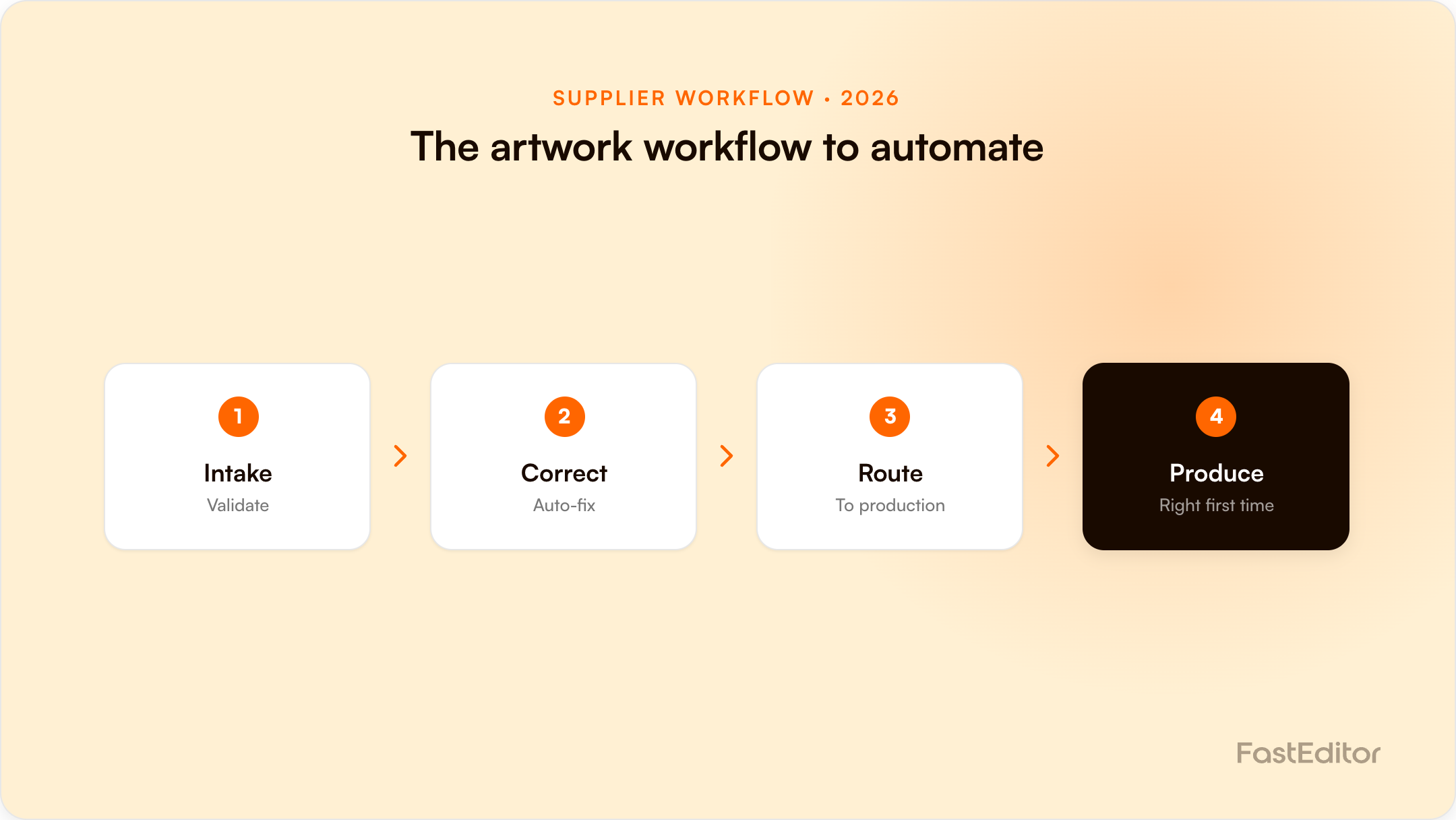
Promo suppliers inherit artwork from dozens of resellers in every format and quality level. PPAI research shows top suppliers are already automating production workflows. This guide maps the five biggest intake pain points to automated fixes, quantifies the time savings, and explains how to evaluate artwork automation and standardise intake across your reseller network.
One in four top promo suppliers has already moved past manual prepress. PPAI's November 2025 flash survey of PPAI 100 suppliers found that 25.5% have already integrated AI into production, order processing or workflow automation, and another 41.8% are actively testing tools for design, quoting and forecasting. Nearly 70% are hands-on with AI today. If incoming artwork still crosses a prepress desk one file at a time, that gap is no longer a back-office detail. It is a competitive problem.
On this page
A mid-sized supplier receives artwork from 20 to 200 resellers. Each reseller has its own customers, its own upload flow, and its own idea of what a print file looks like. The result lands in your inbox as JPEG logos screenshotted from websites, RGB files destined for spot-colour printing, 72 dpi images stretched across a 30 cm print area, and PDFs with no bleed and no safe zone.
The numbers behind that frustration are consistent. FastEditor's Artwork Automation Benchmark 2026, built on 13,773 real logo uploads, found that 85% of files needed at least one automated fix before they were fit for production. 61% needed vectorization and 79% needed upscaling. These are not edge cases. They are the normal state of incoming artwork.
Resellers rarely fix any of this, because they cannot see your specifications. You fix all of it, because the alternative is a misprint and a reprint at your cost. That asymmetry is why suppliers carry the heaviest artwork burden in the promotional products chain.
Every supplier prepress team handles the same five categories of correction, order after order. Each one now has a proven automated equivalent.
| Pain point | Manual reality | Automated step |
|---|---|---|
| Inconsistent file quality | Operators open, inspect and triage every single file | Intake validation checks format, resolution and colour mode at upload |
| Raster logos where vector is needed | Manual redraws taking 15 to 45 minutes each | Automated vectorization in seconds |
| Specs ignored: bleed, size, stroke width | Errors caught late, sometimes after production starts | Spec enforcement at upload, including line thickness checks per decoration method |
| Proofing delays | Days of email back and forth per order | Instant proof generation approved inside the order flow |
| Files arriving in the wrong place or format | Re-exporting and re-routing per machine or method | Automatic file routing to the correct output spec for each decoration technique |
The output of that chain is a production-ready file: correct format, colour mode, dimensions and placement, generated without an operator touching it.
Take a supplier processing 100 decorated orders a day. A conservative 10 minutes of artwork handling per order, covering inspection, correction, proofing and file preparation, adds up to 1,000 minutes. That is over 16 hours of skilled prepress work every working day, the equivalent of two full-time employees doing nothing but repairing other companies' files.
Annualised over 250 working days, that is more than 4,100 hours. And 10 minutes is generous. A raster logo that needs a manual redraw can take 30 to 45 minutes on its own, and the benchmark shows 61% of uploads need exactly that treatment.
Automation collapses the timeline. The benchmark's median time from upload to production-ready file was 53 seconds, fully unattended, with FastEditor delivering 99.95% file accuracy across more than 563,981 product configurations. The commercial proof is just as concrete: Helloprint cut artwork handling time by 80% after automating this workflow.
Not every tool built for designers survives contact with a production floor. Suppliers evaluating platforms in 2026 should test six things:
The bigger shift in 2026 is structural. Instead of every supplier and every reseller solving artwork separately, the correction logic moves into shared infrastructure. When your products and print specifications live in the Product Hub, every connected reseller generates artwork against your exact specs at the moment of ordering. You no longer receive 200 interpretations of your requirements. You receive one standard.
Clean product data is the precondition for this, which is why standardising print data across your catalogue comes first. From there, the supplier go-live playbook walks through bringing your range live across the network of 150+ connected suppliers and their resellers.
Ready to standardise intake? See how suppliers receive production-ready files from every connected reseller, and what onboarding looks like, on the FastEditor for suppliers page.
Suppliers receive files from dozens or hundreds of resellers, each with different formats, quality levels and colour modes. A reseller deals with its own customers' files; a supplier inherits the combined variability of every reseller it serves, which multiplies the manual correction load.
Intake validation, vectorization, colour-mode conversion, spec enforcement such as line thickness and bleed checks, proof generation, and routing of production-ready files to the correct output format per decoration method.
A supplier processing 100 decorated orders a day at 10 minutes of manual artwork handling per order spends about 16.7 hours daily on prepress. Benchmark data shows automation produces a production-ready file in a median of 53 seconds, and Helloprint cut artwork handling time by 80%.
Yes. With an API-first platform, resellers upload artwork inside their own shops and flows, while the supplier receives standardised, spec-compliant production files on every order.
More articles in For Suppliers.
Benchmark note: 13,773 logo uploads were analysed in total (19 November 2025 to 31 May 2026). The correction rates quoted here are measured on the stable instrumentation window of 8,664 uploads, March to May 2026. See the full methodology.
