
Book a demo
Connected supplier

Automate artwork for Toppoint products

Toppoint is a Dutch promotional product supplier specializing in writing instruments, drinkware, technology, and branded merchandise. Long-standing FastEditor partner.
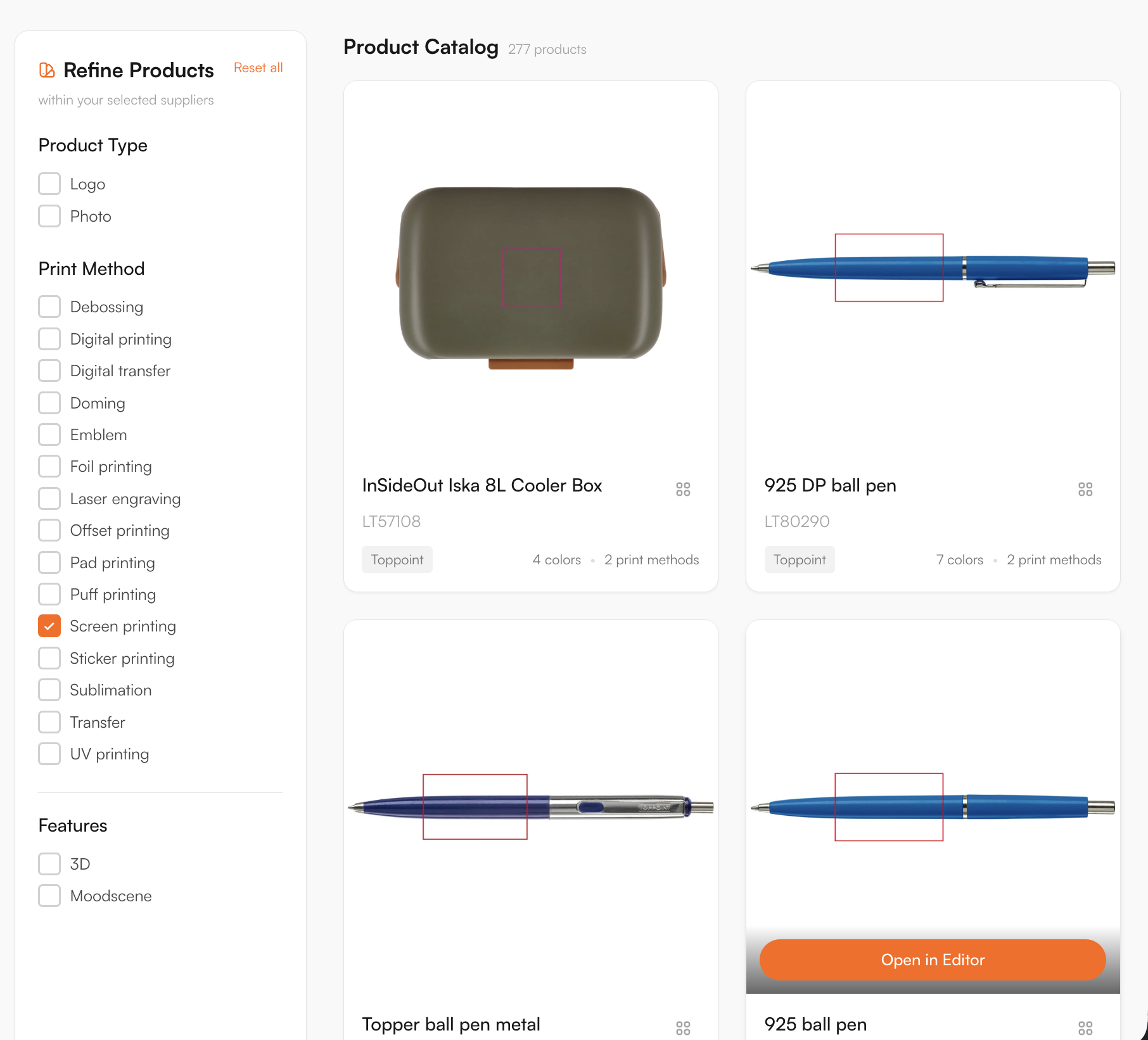
Toppoint catalogue in the FastEditor Product Hub
1567
Products live
Netherlands
Headquarters
Daily
Catalogue sync
Direct API
Integration
Onboarded
Status

Overview

Toppoint is a Dutch promotional products supplier known for writing instruments, drinkware, technology and everyday branded merchandise. For a reseller, its catalogue is deep and well-suited to online personalisation — but every product still comes with its own print areas, decoration methods and file rules to manage.

FastEditor connects to Toppoint by API, with 1,567 products live and synced daily. A customer uploads their logo on your product page, and the file that reaches production is already vectorized, validated against Toppoint's specifications for that product and method, and ready to print. No prepress step, no correction loop.

How the integration works

The Toppoint connection is a direct API integration that refreshes every day, backed by a manual enrichment step so print areas and decoration data are checked and corrected rather than taken raw from the feed.

Three things travel with every product:

  • Print areas. The position, size and shape of each decorable area, enriched and verified so the editor constrains a customer's design to what the product can physically take.
  • Decoration methods. Which techniques are available on that specific product, each carrying its own limits on colour count, line weight and resolution.
  • Product data and variants. Colours, sizes and pricing stay in step with Toppoint's live catalogue through the daily sync.

Decoration methods

Debossing, Digital printing, Digital transfer, Doming, Emblem, Foil printing, Laser engraving, Offset printing, Pad printing, Puff printing, Screen printing, Sticker printing, Sublimation, Transfer, UV printing

Artwork requirements

Toppoint is built around writing instruments and small hard goods, where the decoration area is often only a few millimetres tall. That makes artwork validation less forgiving than on a flat print, and FastEditor checks every upload against the specific product and method before any production file is cut.

  • Fine lines on pens. The print window on a barrel is tiny, so hairline strokes and small type are measured against the minimum reproducible width for pad and screen printing and flagged if they will fill in.
  • Spot-colour limits. Pad and screen positions cap the number of colours, so a multi-colour logo headed for a one- or two-colour barrel print is caught in the editor.
  • Foil, UV and offset. Each carries its own preparation, and the editor previews the finish the chosen method actually produces rather than a flat on-screen mock-up.
  • Formats and resolution. JPG, PNG, PDF, AI and EPS are accepted; raster uploads are vectorized and sized against the real print window.
  • Colour conversion. RGB is mapped to the method's colour space, with Pantone matching where spot colour applies.

The rules follow Toppoint's own specifications, and because the catalogue runs through a manual enrichment step, print areas and colour limits are verified rather than taken raw from the feed.

How to start selling

  1. Pick from the live Toppoint range. Pens, drinkware and tech arrive in the FastEditor Product Hub with their print areas and decoration data already enriched, so you can sell without touching a single spec.
  2. Decide where the designing happens. Embed the Logo Editor on your webshop for customer self-service, or use the Studio Tool in-house when your team builds an order for a client. Both open the product in FastEditor with Toppoint's decoration areas in place.
  3. Fine detail is caught before it prints. On a pen barrel the print window is only millimetres wide, so FastEditor measures the logo against Toppoint's minimum line width and colour limits and shows the customer exactly what will fit.
  4. Toppoint receives a ready-to-run file. Once the design is approved, FastEditor outputs the production file and proof to Toppoint's spec. New ranges join through Toppoint's enrichment step, usually live about two weeks after a feed update.
Book a demo

Logo Editor or Studio Tool?

Two tools, one artwork engine.

Studio Tool

For internal sales & account management teams

✓Browse the catalogue and find any product from the supplier
✓Design it across positions, then download the branded print proof
✓Get production-ready files, no customer order needed
Explore Studio Tool →

Logo Editor

For your webshop

✓Connect to your webshop, linked to the right product by supplier SKU
✓Your customer designs and approves online
✓After the order, you receive the production-ready files
Explore Logo Editor →

Frequently asked questions

How many Toppoint products are available through FastEditor?

1,567 Toppoint products are live in the FastEditor Product Hub. The catalogue connects by API and refreshes daily, with a manual enrichment step keeping print areas and decoration data accurate.

Which Toppoint decoration methods does FastEditor support?

Fifteen methods are mapped, including screen printing, pad printing, offset printing, digital printing, laser engraving, sublimation, debossing, doming, foil printing, puff printing, UV printing and sticker printing. Each product carries the methods available for it, with the colour and line-weight limits that method imposes.

Do Toppoint orders produce a print-ready file automatically?

Yes. Once the design is approved, FastEditor generates the production file for that Toppoint product and method: vectorized, spec-checked for line weight, colour count and resolution, and output in the required colour space. On Toppoint's catalogue the underlying print areas are enriched by hand first, so the file matches what their production expects.

How quickly do new Toppoint ranges go live?

Toppoint's catalogue runs through a manual enrichment flow on top of the daily API sync, so print areas and decoration specifications are verified before products are published. New ranges are typically live around two weeks after a feed update.

Other connected suppliers