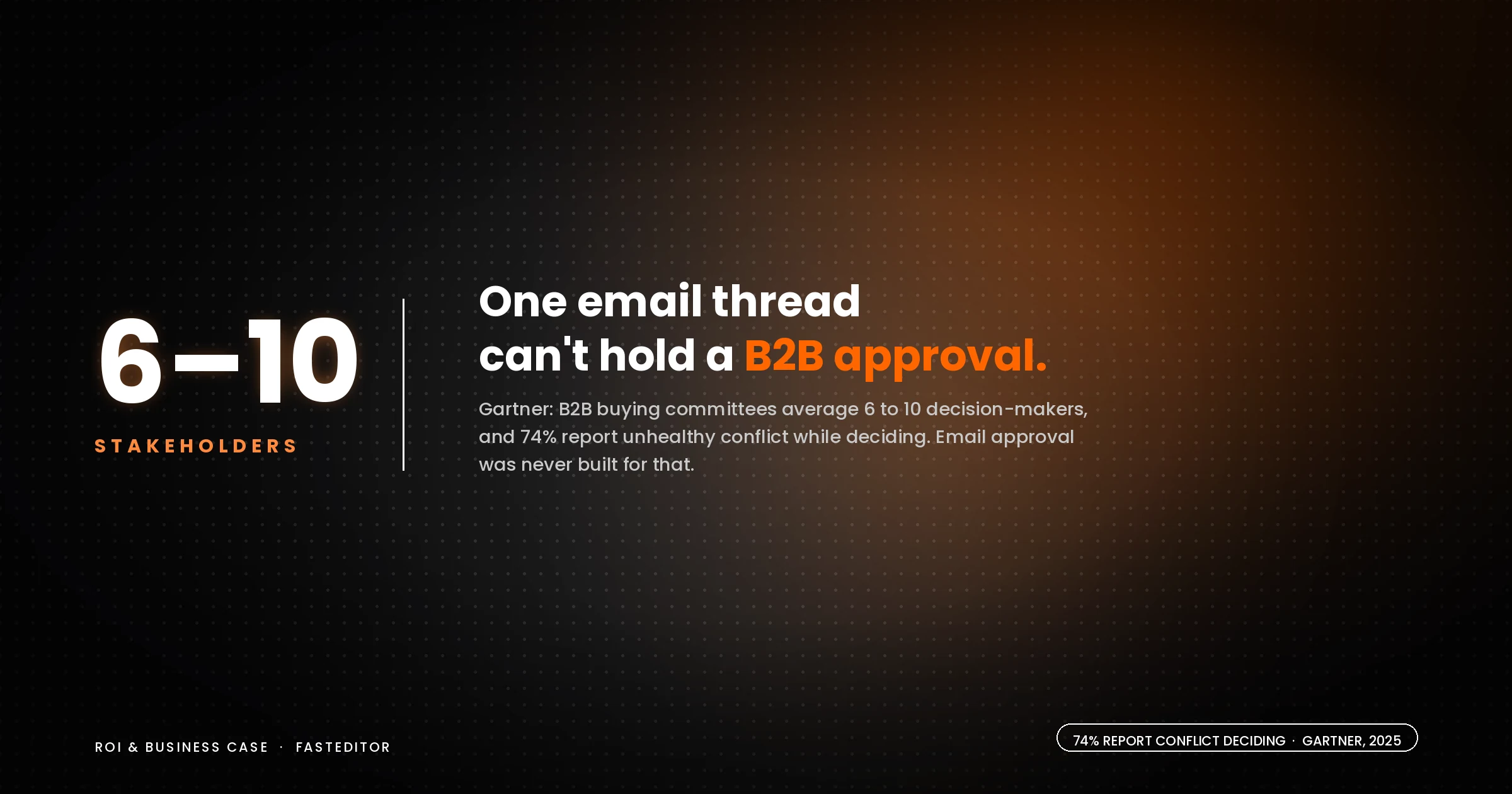
B2B buying committees average 6 to 10 stakeholders, and Gartner found 74% of buying teams show unhealthy conflict during the decision process. Email proof approval has no single source of truth, no version control, and no audit trail, so proofs drift between inboxes, feedback gets lost, and orders stall. A structured, single-link proof with role-based approval and a timestamped record fixes it.
The stakeholder math: Gartner puts the average B2B buying committee at 6 to 10 decision-makers, and a 2025 Gartner sales survey found 74% of buying teams show unhealthy conflict during the decision process. Every one of those people can end up on the same proof approval email thread, with no shared version of the truth.
A logo goes out for approval on a Tuesday. By Friday there are four people on the thread, three PDF attachments with the same file name, and nobody is fully sure which version the brand manager actually signed off on. This is not a one-off mistake, it is what happens by default when a B2B proof approval runs on email. At FastEditor we see this pattern constantly in reseller and supplier workflows: the proof itself can be generated in seconds, and the approval built around it still takes days, because email was never designed to be a system of record.
A consumer order has one buyer. A B2B promotional or print order routinely has several: a purchasing contact at the distributor, a brand or marketing manager at the end client, sometimes a regional office repeating the order for a different market, and a supplier or decorator confirming the file is producible. Gartner's research on B2B buying puts the average committee at 6 to 10 people, up from roughly 5.4 a decade ago, and its 2025 survey found that 74% of buying teams experience unhealthy conflict while deciding. A proof approval is a small buying decision in miniature, and email routes that decision through the least structured tool available for it.
None of this is really about email being a bad piece of software. It is that email was built for correspondence, not for holding a canonical, current, approvable version of anything. As soon as a second person forwards a proof to a third, the thread forks. From there, version drift is not a risk, it is the default outcome.
Each of these failure points is small on its own. Combined, they are why a proof that should close in a day instead drags across a week or more.
| Factor | Email approval | Structured proof link |
|---|---|---|
| Source of truth | Whichever attachment was opened last | One link, always the current version |
| Version history | Manual, based on file naming | Automatic, every revision logged |
| Who approved what | Buried in a reply chain | Timestamped approval field per version |
| Extra approvers | Added silently by forwarding | Added deliberately, with context intact |
| Feedback context | Text only, disconnected from the artwork | Tied to the exact placement, colour, or product |
| Stalled proofs | No prompt to follow up | Visible status, easy to re-share or nudge |
The direct cost is time: a proof that could be approved in a single sitting instead spans several business days while it waits in different inboxes. The indirect cost is worse. A reseller recently introduced to FastEditor came through exactly this pattern: a supplier, a brand manager, and a distributor's own team were still debating a logo placement over email weeks after the colour itself had already been agreed, because nobody could confirm which attachment reflected that agreement. The order did not fail, but it sat in limbo far longer than the actual decision required.
This is also where reprints creep in. If the version an approver signs off on is not unambiguously the version production receives, as covered in why a soft proof can disagree with the final print, a mismatch between what was "approved" and what was produced is not a production error, it is an approval-chain error. Helloprint's experience automating artwork handling, which cut its artwork time by 80%, came largely from removing exactly these handoffs.
Fixing this is not about adding more process to email. It is about moving the approval off email entirely and onto something built to hold a version. A workflow that actually solves multi-stakeholder approval needs:
Because the Studio Tool generates a proof from the product's real decoration data rather than a static mockup, the proof, its locked PMS colour values, and the approval field all live in one place: a single link, not an attachment. Every revision replaces the same link rather than spawning a new file, so a distributor, a brand manager, and a supplier can all open the identical, current version regardless of who forwarded it to whom. Reviewing it in 3D visualisation gives every stakeholder the same reference point, and because the proof and the production-ready file come from the same engine, the version that gets approved is, by construction, the version that reaches production. That single-source design is also what underpins the platform's own numbers: across the 13,773 logo uploads in FastEditor's 2026 benchmark, the median time from upload to a production-ready file was 53 seconds. The bottleneck was never the artwork, it was always the approval chain wrapped around it.
None of this requires the buying committee to shrink. It requires the proof to stop depending on an inbox to stay accurate. Try the Studio Tool and generate a proof link against a real product catalogue to see how a single, versioned link holds up across a multi-stakeholder order.
This sits alongside the broader case for artwork automation: automating the file removes manual work, and automating the approval around it removes the delay that manual work was hiding.
Because they usually route through email, which has no single source of truth, no built-in version control, and no audit trail. With several stakeholders on a thread, each revision and forward increases the chance that different people are looking at different versions.
Gartner research puts the average B2B buying committee at 6 to 10 people, up from about 5.4 a decade ago. A promotional or print order proof often routes through a purchasing contact, a brand or marketing manager, and a supplier or decorator confirming the file is producible.
Version drift happens when a proof is revised but the earlier version keeps circulating, usually as an email attachment with a similar file name. Someone can approve an outdated version without realising it, which is how an "approved" proof and the file sent to production end up disagreeing.
Yes, if the workflow keeps a timestamped record of who approved which version. A single, always-current link with a built-in approval field gives more accountability than an email thread, not less, because there is no ambiguity about which version was signed off.
Yes. Because the link always resolves to the current version, a distributor, a brand manager, and a supplier can each open it independently and see the same proof, the same locked colour values, and the same approval status, without anyone needing to forward a file.